Best ITSM Tools in 2026: A Sourced Comparison (and How to Connect Them)

ITSM tools are software platforms that help IT teams plan, deliver, support and improve IT services through incident, problem, change, request, asset and knowledge management, usually aligned with ITIL 4 practices. The best ITSM tools in 2026 combine those core processes with a CMDB, AI-assisted triage, workflow automation and open integrations, so the service desk can work with development, monitoring and customer support tools instead of in isolation.
This guide compares nine ITSM tools on criteria you can verify: their position in the 2026 Gartner Magic Quadrant, deployment options, public pricing, and how easily they connect to the rest of your stack. Last updated: October 5, 2026.
The short list
- Large, process-heavy enterprise: ServiceNow ITSM or BMC Helix ITSM.
- Engineering-led organization already on Atlassian: Jira Service Management.
- Mid-market team that wants to go live fast: Freshservice or HaloITSM.
- Cost-conscious or on-premises requirement: ManageEngine ServiceDesk Plus.
- Any combination of the above: plan for an integration layer from day one. Most enterprises end up running more than one service tool.
What changed in the ITSM market in 2026
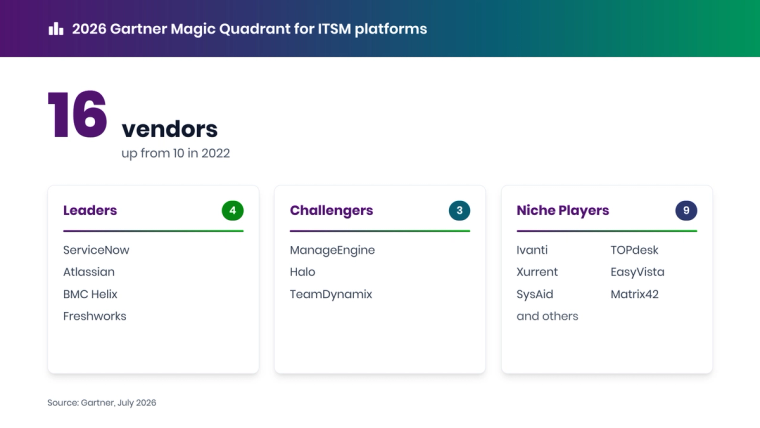
Gartner published its 2026 Magic Quadrant for IT Service Management Platforms in July 2026, and the field looks very different from the last edition in 2022. The report now evaluates 16 vendors, up from 10, and seven of them are new to the quadrant. Gartner describes ITSM platforms as the system of record that lets infrastructure and operations leaders deliver integrated IT services, which is a polite way of saying that if your ITSM tool cannot talk to everything else, it is not doing its job.
Four vendors are Leaders: ServiceNow, Atlassian, BMC Helix and Freshworks. BMC says this is its tenth time as a Leader in the ITSM Magic Quadrant, while Freshworks joined the Leaders quadrant. ManageEngine, Halo and TeamDynamix are Challengers, and Ivanti, TOPdesk, Xurrent, EasyVista, SysAid, Matrix42 and others sit in the Niche Players quadrant. Freshworks, citing Gartner data, puts the ITSM platforms market at nearly $9 billion in 2025, growing 13.74% year over year.
Three trends explain the shake-up. First, AI moved from chatbot demos to agentic triage, summarization and resolution suggestions inside the agent workspace. Second, mid-market platforms caught up on ITIL depth, which is why tools like Freshservice and HaloITSM now compete for enterprise deals. Third, buyers stopped expecting one tool to do everything. Service desks, developers, security teams and customer support increasingly keep their own tools and expect them to stay in sync.
How we compared the tools
Feature checklists make every ITSM tool look identical, because every vendor ticks "incident management". We used criteria that actually separate them:
- Analyst position: placement in the 2026 Gartner Magic Quadrant for ITSM Platforms, as confirmed by Gartner or the vendor.
- Deployment: SaaS only, or also self-hosted for regulated environments.
- Pricing transparency: whether list prices are public, as of October 2026.
- Best fit: the organization size and operating model the tool serves best.
- Integration readiness: whether it can be connected to DevOps, monitoring, CRM and other ITSM tools without custom code. We checked this against the ZigiOps connector catalog.
Best ITSM tools in 2026: comparison table
| ITSM tool | 2026 Gartner MQ | Deployment | Public pricing (Oct 2026) | Best fit | No-code connector in ZigiOps |
|---|---|---|---|---|---|
| ServiceNow ITSM | Leader | Cloud (Now Platform) | No, quote-based | Large enterprises standardizing on one platform | Yes |
| Jira Service Management | Leader (Atlassian) | Cloud or Data Center | Yes: Free up to 3 agents, Standard $20 and Premium $51.42 per agent/month (monthly billing) | Engineering-led organizations on Atlassian | Yes |
| BMC Helix ITSM | Leader (10th time) | SaaS or on-premises | No, quote-based | Complex hybrid estates, Remedy heritage | Yes |
| Freshservice | Leader (Freshworks) | SaaS | Yes: $19, $49 and $99 per agent/month (billed annually), Enterprise on quote | Mid-market and fast-moving enterprise IT | Yes |
| ManageEngine ServiceDesk Plus | Challenger | Cloud or on-premises | Edition-based, published by region | Cost-conscious teams, on-premises needs | Yes |
| HaloITSM | Challenger (Halo) | Cloud or on-premises | Per agent, on request | Mid-market and MSP-style service teams | Yes |
| Ivanti Neurons for ITSM | Niche Player | Cloud or on-premises | No, quote-based | Organizations already using Ivanti endpoint tools | Yes |
| TOPdesk | Niche Player | SaaS | No, quote-based | European public sector, education, shared services | Yes |
| Zendesk | Not evaluated as an ITSM platform | SaaS | Yes, per agent | Customer support and light internal IT | Yes |
Pricing sources: Jira Service Management pricing and Freshservice pricing, checked October 2026. Vendors change plans often, so treat these as a starting point, not a quote.
The ITSM tools, one by one
1. ServiceNow ITSM
The default choice for large enterprises, and a Leader again in 2026. ServiceNow's strength is breadth: ITSM, ITOM, a mature CMDB, HR and customer service workflows, and Now Assist AI on one platform. The trade-offs are cost and complexity. Licensing is quote-based, implementations often need a partner, and connecting ServiceNow to non-ServiceNow tools through IntegrationHub spokes adds its own subscription line. Our breakdown of the real cost of a ServiceNow integration compares IntegrationHub, iPaaS and ZigiOps side by side.
2. Jira Service Management
Atlassian was named a Leader in the 2026 Magic Quadrant, and Jira Service Management is the natural pick when developers already live in Jira. Requests, incidents and changes sit next to the engineering backlog, and Assets covers configuration data. Pricing is public and starts with a free tier for three agents. Watch for ITIL depth in very process-heavy organizations, and plan carefully if you run Data Center, which has its own licensing and upgrade cycle.
3. BMC Helix ITSM
The heir to BMC Remedy and a ten-time Leader. BMC Helix is strong in large, hybrid environments that need both SaaS and on-premises options, deep CMDB and discovery, and a link to observability. BMC is also the only vendor recognized in both the 2026 ITSM and Observability Platforms Magic Quadrants, according to its own announcement. Expect a substantial implementation effort, and if you are moving from Remedy, map every existing integration before you migrate.
4. Freshservice
Freshworks reached the Leaders quadrant in 2026, and Freshservice is the clearest example of a mid-market tool moving upmarket. It is SaaS-only, priced publicly per agent, and Freshworks says customers go live in under 90 days. Freddy AI Copilot is an add-on at $29 per agent per month. It suits teams that value speed and usability over deep customization. Very large, heavily customized ITIL environments may still find the ceiling sooner than with ServiceNow or BMC.
5. ManageEngine ServiceDesk Plus
A Challenger in 2026 and a favorite of budget-aware IT teams. ServiceDesk Plus is available both in the cloud and on-premises, which matters for government, defense and other regulated buyers. It covers ITIL processes, asset management and a project module, and plugs into the wider ManageEngine and Zoho tooling. The interface is more functional than elegant, and complex cross-tool workflows usually need an external integration layer.
6. HaloITSM
Halo enters 2026 as a Challenger. HaloITSM is known for flexible configuration, ITIL-aligned workflows and a choice of cloud or on-premises hosting, and it has strong traction with UK and European mid-market organizations. Its ecosystem of marketplace apps is smaller than ServiceNow's or Atlassian's, so check connector coverage for your DevOps and monitoring tools early.
7. Ivanti Neurons for ITSM
Ivanti was a Leader in earlier editions and is a Niche Player in 2026. Its value is strongest for organizations already using Ivanti for endpoint and asset management, where service and device data live side by side. It runs in the cloud or on-premises. Ask about the roadmap, especially if you inherited Cherwell through Ivanti's acquisition and need to plan a consolidation.
8. TOPdesk
A Dutch vendor and a Niche Player in 2026, TOPdesk is popular with European universities, public bodies and shared-service centers that run IT, facilities and HR from one desk. It is easy to adopt and strong on enterprise service management. US coverage is thinner, and engineering-heavy teams will want a solid bridge to Jira or Azure DevOps.
9. Zendesk
Zendesk is not in the ITSM Magic Quadrant, but it belongs on this list because so many escalations start there. Customer support teams run on Zendesk, then hand defects and outages to IT and engineering. Treat it as part of your service ecosystem rather than your ITSM system of record, and make sure tickets can move to ServiceNow, Jira or your chosen ITSM tool without copy and paste.
Can one ITSM tool also run HR, facilities and other service teams?
Often, yes. Most tools on this list now market enterprise service management (ESM), which applies the same request, approval and knowledge workflows to HR, facilities, legal and finance. ServiceNow, Jira Service Management, TOPdesk and HaloITSM are particularly strong here. Two cautions apply. First, ESM licenses are usually priced per agent like IT licenses, so a 30-person HR team can change the business case. Second, departments that already run their own systems, such as an HR suite or a facilities platform, rarely give them up. In that case, keeping the existing tool and syncing requests with the central service desk is usually faster and cheaper than forcing everyone onto one platform, and it avoids a migration project nobody asked for.
Why your ITSM tool stack needs an integration layer
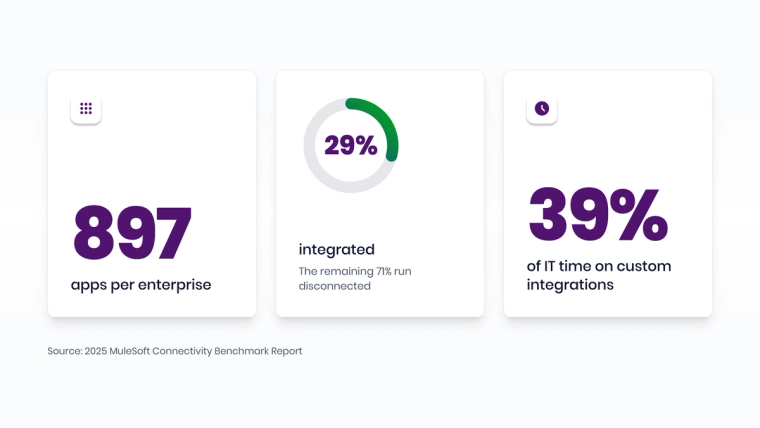
Here is the uncomfortable truth no vendor comparison mentions: whichever ITSM tool you choose, it will not be the only one. According to the Zylo 2026 SaaS Management Index, the average organization now runs a portfolio of 305 SaaS applications, with average annual SaaS spend of $55.7 million. Every one of those tools holds data that someone, sooner or later, will need in a ticket.
In practice, the service desk runs ServiceNow, developers run Jira or Azure DevOps, support runs Zendesk, and monitoring tools such as Dynatrace or Datadog raise the alerts. A merger adds a second ITSM instance. An MSP adds a third. Each handoff between those tools is a place where tickets get copied by hand, updates go missing and SLAs quietly slip.
That is why integration readiness belongs on the ITSM scorecard, not in the "phase two" folder. Before you sign, list every system the new tool must exchange records with, and decide how those connections will be built and maintained. Our no-code ITSM integration platform buyer's guide covers that evaluation in detail.
How does ZigiOps connect ITSM tools without code?
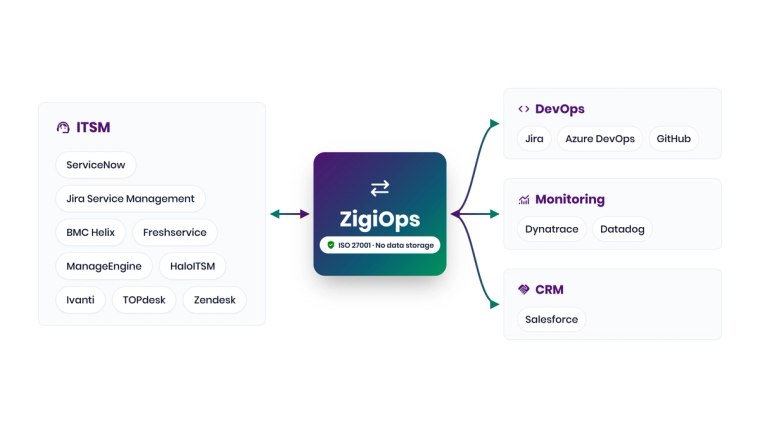
ZigiOps is a standalone, no-code integration platform with connectors for every tool in the table above, from ServiceNow and Jira Service Management to BMC Helix, Freshservice, ManageEngine ServiceDesk Plus, HaloITSM, Ivanti, TOPdesk and Zendesk. It also connects them to DevOps, monitoring and CRM systems such as Jira, Azure DevOps, GitHub, Dynatrace, Datadog and Salesforce.
Every integration is built in a guided UI from the same building blocks:
- Connected systems: URL and credentials for each tool, stored in ZigiOps.
- Templates: bundled starting points such as "ServiceNow incidents to Jira tasks" or "Remedy incidents to Jira tasks".
- Triggers and conditions: polling or listener triggers, filtered so only the right records move.
- Correlation: each record stores its counterpart's ID, so updates sync in both directions without duplicates.
- Field mapping and expressions: priorities, statuses, comments and attachments are mapped and transformed in transit.
What makes this matter for ITSM specifically: ZigiOps does not store any of the data it transfers, it is ISO 27001 certified, and it runs as a standalone application rather than a plugin inside one of your ITSM tools. Licensing is based on connected system pairs with unlimited transactions, so a busy service desk does not get penalized for volume. The ZigiOps security overview has the details your security team will ask for.
How to choose the right ITSM tool: a 7-step checklist
- Map your processes, not your wish list. Which ITIL practices do you actually run today: incident, request, change, problem, asset, knowledge? Buy for those first.
- Count agents honestly. Per-agent pricing looks cheap at 20 agents and very different at 400. Model three years, including AI add-ons.
- Decide on deployment early. If regulators or customers require on-premises hosting, the list shrinks fast to BMC Helix, ManageEngine, HaloITSM, Ivanti and Jira Data Center.
- Check the CMDB story. Change and incident management are only as good as your configuration data. Ask how discovery and CI updates work, and which external sources can feed the CMDB.
- Test AI on your own tickets. Every vendor demos AI on clean data. Ask for a proof of value on a sample of your real, messy tickets.
- List every integration before you sign. DevOps, monitoring, CRM, HR, identity, other ITSM instances. For each one, decide whether it will be native, scripted or handled by a no-code platform, and who maintains it.
- Plan the migration path. Moving from one ITSM tool to another usually means running both for a while. Keep records in sync during the transition so neither team works blind.
Common ITSM tool pairings, and how to connect them
ServiceNow + Jira: the classic split between IT operations and engineering. Incidents and problems that need a code fix become Jira issues, and status and comments come back. See the ServiceNow and Jira integration for the field-level detail.
Zendesk + ServiceNow or Jira Service Management: customer-facing support escalates to internal IT without the agent leaving Zendesk, and the customer sees progress automatically.
BMC Helix + Jira or Azure DevOps: large enterprises keep Helix as the ITSM system of record while development teams stay in their own tools. ZigiOps offers ready-made BMC Helix integrations for both.
Monitoring tools + any ITSM tool: alerts from Dynatrace, Datadog, SolarWinds or Zabbix open and update incidents automatically, and resolve them when the alert clears.
ServiceNow + Jira Service Management: common after mergers, or when a business unit prefers Atlassian. If you are still deciding between the two, our ServiceNow vs. Jira Service Management comparison is a good next read.
The bottom line
There is no single best ITSM tool, only the best fit for your size, processes and hosting constraints. ServiceNow and BMC Helix lead for complex enterprises, Jira Service Management for engineering-led teams, Freshservice and HaloITSM for speed in the mid-market, and ManageEngine for cost and on-premises flexibility. What every option has in common is that it must work alongside the rest of your stack. Choose the ITSM tool for your processes, and choose a no-code, no-data-storage integration layer so it never becomes another silo.
Running more than one ITSM, DevOps or support tool? Book a demo and we will connect two of them live, without writing a line of code.
Frequently asked questions
Which ITSM tools are Leaders in the 2026 Gartner Magic Quadrant?
The 2026 Gartner Magic Quadrant for IT Service Management Platforms, published in July 2026, names four Leaders: ServiceNow, Atlassian (Jira Service Management), BMC Helix and Freshworks (Freshservice). It evaluates 16 vendors in total.
Is there a free ITSM tool?
Yes. Jira Service Management has a free plan for up to three agents. It suits small teams and pilots; most organizations move to a paid plan once they need more agents or advanced incident and asset features.
Can Jira Service Management replace ServiceNow?
For many mid-size and engineering-led organizations, yes. Very large enterprises with deep ITOM, CMDB and cross-department workflows often keep ServiceNow and connect it to Jira or Jira Service Management instead of replacing it.
Can ServiceNow and Jira Service Management work together?
Yes. With an integration platform such as ZigiOps, incidents, requests, comments, attachments and status changes sync between ServiceNow and Jira Service Management in both directions, with no scripting.
Can you integrate ITSM tools without code?
Yes. ZigiOps connects ServiceNow, Jira Service Management, BMC Helix, Freshservice, ManageEngine ServiceDesk Plus, HaloITSM, Ivanti, TOPdesk and Zendesk through a guided, 100% no-code UI with templates, conditions, correlation and field mapping.
Does ZigiOps store ticket data from my ITSM tools?
No. ZigiOps transfers and transforms records in transit and does not store the data it moves. It is ISO 27001 certified and can run on-premises or in the cloud.
What is the difference between ITSM and ITOM tools?
ITSM tools manage how IT services are requested, delivered and supported, through tickets, changes and knowledge. ITOM tools monitor and manage the infrastructure behind those services, such as events, performance and discovery. Most enterprises integrate the two so alerts open and resolve incidents automatically.