Middleware Software in 2026: ESB vs. Low-Code iPaaS vs. No-Code iPaaS

Middleware software is the layer that sits between applications and lets them exchange data, trigger actions and stay in sync without each system having to know how the other one works. In 2026 it comes in four practical flavors: a traditional enterprise service bus (ESB), message brokers, general-purpose low-code iPaaS, and no-code iPaaS platforms such as ZigiOps that add deep, two-way integration across ITSM, DevOps, monitoring and CRM tools at enterprise scale. The right choice depends less on the label and more on who will build the integrations, how complex and high-volume they are, where the data is allowed to live, and how you want to pay as volume grows.
If you run a service desk, an operations center or a DevOps toolchain, "middleware" is probably a word you hear in two very different meetings. In one, an architect explains why the old ESB is still running the order-to-cash flow and nobody dares touch it. In the other, a service manager asks why incidents from Dynatrace still reach ServiceNow by email. Both conversations are about middleware. They just need very different answers. This guide explains what middleware software is today, how ESB, low-code iPaaS and no-code iPaaS actually differ, and how to pick the right layer for IT operations work. Last updated: October 19, 2026.
What is middleware software?
IBM defines middleware as software that enables one or more kinds of communication or connectivity between applications or components in a distributed network. In plain terms, it is the glue. Your monitoring tool does not need to speak ServiceNow's API, and Jira does not need to understand Azure DevOps work item types, because something in the middle translates, routes and delivers the data.
That "something" has taken many shapes over the last 30 years. IBM's own list of middleware types runs to more than ten categories, including message-oriented middleware, API middleware, transactional middleware, data middleware and enterprise application integration middleware. For an IT team choosing a tool in 2026, most of those categories collapse into four buying decisions:
- Enterprise service bus (ESB): a central bus that routes, transforms and orchestrates messages between many applications, usually run on your own infrastructure.
- Message brokers and streaming platforms: infrastructure such as queues and event streams that move messages reliably, but leave mapping and business logic to your developers.
- General-purpose iPaaS (integration platform as a service): cloud platforms with large connector libraries and low-code flow builders, typically used for business process automation.
- No-code iPaaS built for integration depth: platforms such as ZigiOps that run in the cloud or on-premises, connect dozens of enterprise systems (for example ServiceNow, Jira, Azure DevOps, Dynatrace or Salesforce) through a guided UI, and handle complex two-way use cases and high record volumes without code.
Why does middleware still matter in 2026?
Because the number of systems keeps outrunning the number of connections. The MuleSoft 2025 Connectivity Benchmark Report found that the average enterprise manages 897 applications, only 29% of them are integrated, and IT teams spend 39% of their time building custom integrations. The same report says 95% of organizations face challenges integrating AI into existing processes, with 80% naming data integration as the biggest obstacle.
Translated into an ITSM context: your agents, your AIOps tooling and your engineers all need the same incident, alert and work item data, and most of it is still sitting in separate tools. Middleware is how you close that gap without hiring a team of integration developers.
The four types of middleware, explained without the jargon
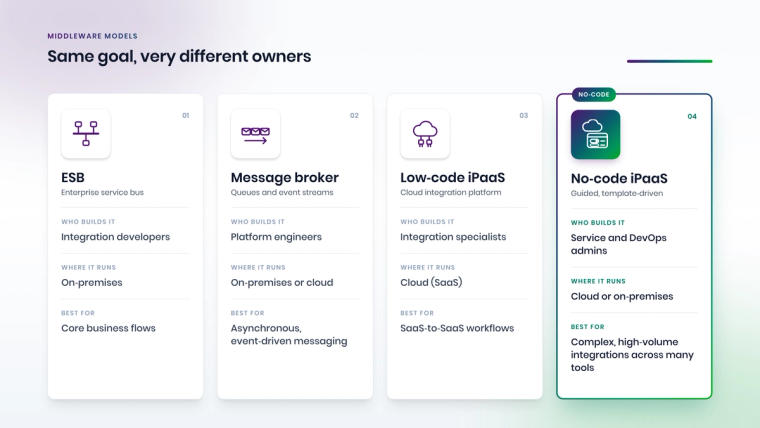
1. Enterprise service bus (ESB)
An ESB is a central message backbone. Applications publish messages to the bus, and the bus handles routing, protocol conversion, transformation and orchestration before delivering them to the right consumer. It was the flagship pattern of service-oriented architecture (SOA) in the 2000s and early 2010s.
ESBs are still excellent at what they were designed for: high-volume, tightly governed, on-premises integration between core business systems. They are less excellent at speed of change. Every new flow is usually a development project, ESB skills are specialized, and the bus itself becomes a critical piece of infrastructure that needs its own upgrades, monitoring and high availability.
2. Message brokers and event streaming
Message brokers and streaming platforms move messages reliably between producers and consumers. They are the plumbing of event-driven architecture and are great for decoupling microservices. What they do not do is understand business objects. A broker will happily deliver a payload to ServiceNow, but it will not map Dynatrace severity to ServiceNow impact and urgency, find the existing incident, or sync the resolution note back. Your developers write all of that.
3. General-purpose iPaaS (low-code)
iPaaS moved integration to the cloud. General-purpose platforms offer large connector libraries, visual or low-code flow builders, API management and, increasingly, AI features, and they are a common choice for connecting HR, finance, marketing and sales apps across the company. But iPaaS is a delivery model, not a single product type: no-code iPaaS platforms like ZigiOps cover the same ground with a different trade-off, which we explain in type 4.
The trade-offs of general-purpose, low-code iPaaS for IT operations teams are worth knowing:
- Low-code is still code-adjacent. Complex ITSM logic such as correlation, conditional state mapping and two-way comment sync often ends up in scripts, formula steps or custom connectors.
- Pricing is frequently metered by tasks, connections, recipes or data volume. Incident storms and noisy monitoring tools can make that meter spin fast.
- Data handling varies. Some platforms log or retain payloads for replay and troubleshooting, which may matter for your security review.
If you want a deeper definition of the category, our guide What Is iPaaS? A 2026 Definition (and What It's Missing) covers it in detail.
4. No-code iPaaS built for integration depth and scale
The newest flavor of iPaaS removes the code and adds depth. Instead of giving you a blank canvas, these platforms understand the entities you work with: incidents, problems, changes, alerts, events, issues, work items, cases and configuration items. They ship with templates for common flows, let your team configure field mapping, conditions and two-way sync without writing code, and are built to run many integrations across many tools from one engine.
ZigiOps is a no-code iPaaS of this kind. It runs as hosted SaaS in the cloud or on-premises, connects 60+ enterprise systems across ITSM, ITOM, DevOps, monitoring, cloud and CRM, and is stateless: it reads from the source, transforms data in memory and writes to the target without keeping a copy of your records. It is designed for three things at once: integration depth (complex, conditional, two-way use cases), breadth (many tools connected through one engine, whether that is three systems or sixty) and volume (high numbers of tickets, alerts and requests, with no per-transaction metering).
ESB vs. low-code iPaaS vs. no-code iPaaS: side-by-side comparison
The table below compares the main middleware models on the criteria IT operations teams usually care about. Vendor-specific details vary, so treat it as a map, not a price list.
| Criteria | Traditional ESB | Message broker / streaming | General-purpose iPaaS (low-code) | Native connectors (e.g. Integration Hub spokes, marketplace apps) | No-code iPaaS (ZigiOps) |
|---|---|---|---|---|---|
| Primary job | Route, transform and orchestrate messages between many systems | Move messages and events reliably | Connect business apps with cloud flows and APIs | Extend one platform to reach others | Connect and sync ITSM, ITOM, DevOps, monitoring and CRM systems two ways, at depth and at scale |
| Where it runs | Mostly on-premises | On-premises or managed cloud | Vendor cloud | Inside the host platform | Cloud (hosted SaaS) or on-premises, same engine |
| Who builds integrations | Integration developers | Software engineers | Developers or trained power users | Platform admins and developers | Service, ITOM or DevOps admins in a guided UI |
| Business logic (mapping, correlation, conditions) | Custom development | Written in consumer code | Visual flows plus scripts for edge cases | Platform flow designer, scripts | Built-in field mapping, trigger conditions, expressions and correlation |
| Typical pricing model | Licenses plus infrastructure and specialist staff | Infrastructure or consumption | Subscription, often metered by tasks, connections or volume | Add-on subscription to the host platform | License points per connected system-instance pair, unlimited integrations between that pair |
| Data persistence | Often queues and persists messages | Persists messages by design | Varies, some retain payloads and logs | Stored in the host platform | Stateless, no copy of records stored |
| Best fit | Stable, high-volume core business flows | Event-driven applications and microservices | Company-wide business process automation | Single-vendor use cases inside one ecosystem | Complex, high-volume integrations across many enterprise tools |
Sources: IBM on middleware types, ServiceNow Integration Hub, ZigiOps security and ZigiOps product documentation.
Is the ESB dead?
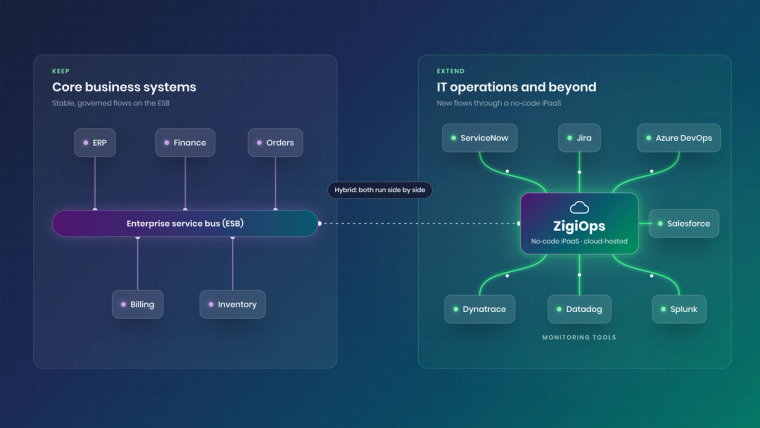
Not dead, but no longer the default. Plenty of banks, insurers and manufacturers still run ESBs for core transactional flows, and replacing a stable bus just because it is unfashionable is rarely a good use of budget.
What has changed is where new integration work goes. New SaaS tools arrive with REST APIs and webhooks, the people who need integrations are often service owners rather than developers, and change velocity is higher than an ESB release cycle can absorb. So most organizations now run a hybrid: the ESB keeps the core, and newer flows land on iPaaS platforms, low-code or no-code. If you are mapping that hybrid architecture, our piece on hub-and-spoke vs. mesh integration architecture walks through the patterns.
Is native integration enough, or do you still need middleware?
Native connectors are the first thing most teams try. ServiceNow's Integration Hub offers prebuilt "spokes" for hundreds of apps, and most ITSM and DevOps tools have a marketplace full of connector apps. For a one-direction notification or a simple lookup, native is often fine.
The limits show up when you need true two-way sync between two platforms that each think they are the system of record. Native connectors live inside one vendor's platform, use that platform's licensing, and are usually strongest at pulling data into that platform rather than keeping both sides equal. We unpacked the hidden costs in Native Integrations vs. Middleware and compared the options for ServiceNow specifically in iPaaS vs Native APIs (IntegrationHub or Middleware).
What middleware integrates ServiceNow with the rest of your stack?
This is one of the most common questions we hear, and the honest answer is "any of the four can, but they do it differently":
- ESB: possible through ServiceNow's REST and SOAP APIs, but every table, field and state transition is custom development.
- Message broker: can carry ServiceNow events, but needs custom producers and consumers on both ends.
- Low-code iPaaS: good for simple create and update flows. Two-way comment, attachment and state sync usually needs extra logic.
- Native (Integration Hub spokes or Store apps): fast to start inside ServiceNow, typically licensed as a ServiceNow add-on.
- No-code iPaaS such as ZigiOps: connects ServiceNow to Jira, Azure DevOps, Dynatrace, Splunk, SolarWinds, Zendesk, Salesforce and many other systems through templates, with correlation, conditional logic and two-way sync configured in the UI.
For a cost view of the same decision, see The Real Cost of a ServiceNow Integration in 2026.
How a no-code iPaaS works under the hood
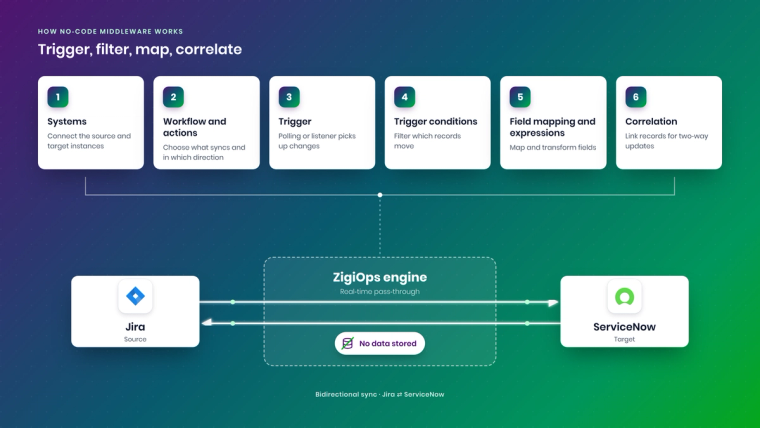
"No-code" can sound like a marketing word, so here is what actually happens inside a platform like ZigiOps when it connects, for example, Jira and ServiceNow:
- Systems: you add each tool as a connected system with its URL and credentials, and ZigiOps reads its schema, including custom fields.
- Workflows and actions: a workflow pairs two systems and defines the entities to integrate, such as Jira tasks and ServiceNow incidents. Each action has a Source tab (what to collect) and a Target tab (how to deliver it).
- Triggers: a polling trigger queries the source API on a schedule (the documentation recommends a 1-minute interval for typical use cases), while a listener trigger opens an HTTPS endpoint that receives data pushed from the source, such as webhook alerts.
- Trigger conditions: filters decide which records qualify, for example "priority is one of P1, P2" and "created by is not the integration user", which prevents sync loops.
- Field mapping and expressions: you map source fields to target fields, combine values with static text, and use conditional mapping or expressions such as "Last Time" to collect only records changed since the last run.
- Correlation: a mapped field (for example the Jira key stored in ServiceNow's correlation_id) links the two records, so later changes, comments and state updates go to the right place in both directions.
None of that requires a developer, and all of it can be changed by the team that owns the process. That is the practical difference between "low-code" and "no-code" for ITSM work.
How to choose the right middleware for IT operations
Use these questions as a quick filter before you book any vendor calls:
- Who will maintain the integrations a year from now? If the answer is your service desk or ITOM admins, a developer-centric ESB or broker is a poor fit.
- Where may the data live? If your security team prefers integration tools that do not persist ticket data, ask every vendor exactly what they store, for how long, and where. ZigiOps' approach is described on our security and compliance page.
- How is volume priced? Model a bad week: an incident storm, a major release and a migration. Task- or volume-metered pricing can surprise you. ZigiOps uses license points per connected system-instance pair, with unlimited integrations between that pair.
- Do you need real two-way sync? Comments, attachments, state changes and resolution notes flowing both ways with correlation is a different problem from "create a ticket when X happens".
- On-premises, cloud, or both? Regulated teams often need the option to run integration inside their own network.
- How many systems, and how much volume? Whether you connect three tools or sixty, the platform has to scale with you. Check how many systems one engine can connect, whether pricing jumps with each new tool or each transaction, and whether complex flows still hold up during an incident storm. ZigiOps connects 60+ systems from one engine, with unlimited integrations and transactions between each licensed system pair.
Where ZigiOps fits in a middleware strategy
ZigiOps does not try to replace your ESB for core order processing. As a no-code iPaaS, it covers the integration work most IT organizations struggle with most: complex, two-way flows between ITSM, ITOM, DevOps, monitoring, cloud and CRM tools, at enterprise scale and without developers. It brings:
- 100% code-free integrations configured in a guided UI, with ready-made templates you can adapt.
- Integration depth and scale: complex conditional and two-way use cases, many tools connected through one engine, and high volumes of tickets, alerts and requests.
- No data storage: a stateless engine that processes records in memory.
- ISO 27001 certified, with encrypted connections and vaulted credentials.
- Unlimited transactions, so incident storms do not turn into invoice storms.
- A standalone application, not a plugin tied to one vendor's platform, available as a cloud iPaaS (hosted SaaS) or on-premises.
Real customers use it exactly this way. PEXA chose ZigiOps partly because a stateless integration cleared their security review, and COCC replaced fragile scripts and cut cross-system ticket handling time by about 50% (COCC case study).
The bottom line
Middleware software is not one product category anymore. ESBs still run the core, brokers move events, and iPaaS connects everything else. Low-code iPaaS suits developer-led business automation, while no-code iPaaS platforms like ZigiOps add the depth, scale and security that ITSM, monitoring and DevOps integrations need. The best architectures put each integration where the people who own it can actually maintain it.
If your integration backlog is full of "ServiceNow to Jira", "Dynatrace to ServiceNow" or "Azure DevOps to Salesforce" requests, you probably do not need another bus. You need an iPaaS your operations team can configure in an afternoon and scale to every tool in your stack. Book a demo and we will build one of your flows live, or browse the full list of ZigiOps integrations first.
Frequently asked questions
What is middleware software in simple terms?
Middleware software is the layer between applications that lets them exchange data and trigger actions without being hard-wired to each other. It translates formats, routes messages and delivers data, so a monitoring tool, a service desk and a DevOps tracker can work together.
Can an iPaaS replace an enterprise service bus (ESB)?
For many new cloud and SaaS integrations, yes. For high-volume, on-premises core business flows that already run well on an ESB, a full replacement is often not worth the risk. Most enterprises run a hybrid where the ESB keeps the core and new integrations land on iPaaS platforms, low-code or no-code.
Is ZigiOps middleware or an iPaaS?
Both. ZigiOps is a no-code iPaaS (integration platform as a service) that acts as middleware between ITSM, ITOM, DevOps, monitoring, cloud and CRM tools such as ServiceNow, Jira, Azure DevOps, Dynatrace, Splunk and Salesforce. It runs in the cloud as hosted SaaS or on-premises, and is built for complex two-way use cases, many connected tools and high record volumes.
Can middleware integrate ServiceNow with Jira without code?
Yes, with a no-code platform such as ZigiOps. You connect both systems, pick a template or build a workflow, set trigger conditions and field mapping in the UI, and use a correlation field so comments, state changes and updates sync both ways.
Does ZigiOps store the data it transfers?
No. ZigiOps is stateless by design. It reads data from the source system, transforms it in memory and writes it to the target system without keeping a copy of your records.
Is middleware the same as an API?
No. An API is the interface a single application exposes. Middleware is the software that uses those APIs (and other protocols) to connect multiple applications, handle mapping and transformation, and keep the data flowing between them.
Can no-code middleware handle many tools and high volumes, such as incident storms?
Yes, if it is designed for it. ZigiOps connects 60+ systems from one engine, supports polling and listener triggers, filtering with trigger conditions, and primary/backup high-availability setups, and its licensing is based on connected system pairs rather than per-transaction metering, so volume spikes do not increase the cost.