ServiceNow Integrator Guide: Features, Pitfalls, Best Practices

Why Enterprise Teams Need a ServiceNow Integrator Today
Modern IT ecosystems combine dozens of systems across ITSM, DevOps, monitoring, cloud, and customer support. ServiceNow often sits at the center of these workflows, yet connecting it to the rest of the environment remains one of the biggest operational challenges for organizations seeking robust servicenow integrations. A reliable servicenow integrator becomes the cornerstone of operational excellence, enabling seamless data flow and automated workflows across complex enterprise environments.
Many organizations still rely on manual updates, spreadsheets, one-off scripts, or fragile point-to-point connectors. These solutions work until a field changes, an API is updated, or the business scales. When that happens, workflows break, SLAs suffer, and teams scramble to maintain visibility across platforms. The need for a reliable servicenow integrator becomes critical when these manual processes can no longer support enterprise-scale operations, making the selection of the right integration platform a strategic imperative for IT leadership.

The complexity of modern IT environments demands more than basic connectivity. Organizations need sophisticated servicenow integrations that can handle complex data transformations, maintain security compliance, and scale with growing business requirements. As enterprise systems become more interconnected, the role of a powerful servicenow integrator becomes fundamental to operational success, serving as the backbone that enables true digital transformation and operational efficiency.
As a result, more enterprises are actively evaluating which servicenow integrator can deliver secure, scalable, and automated workflows without introducing risk. The selection process requires careful consideration of integration capabilities, security features, and long-term scalability to ensure the chosen platform can support evolving business needs while maintaining the agility required for competitive advantage.
This comprehensive guide walks through the essential features, red flags, and selection criteria IT teams should consider when choosing a servicenow integrator. We'll explore real-world implementation scenarios, examine the technical requirements for enterprise-grade solutions, and provide actionable insights for making informed decisions that will drive operational excellence and business value.

What Is a ServiceNow Integrator? (And Why It Matters for Modern IT Operations)
A servicenow integrator is a specialized platform that connects ServiceNow with external systems like Jira, Azure DevOps, BMC Remedy, Salesforce, Freshservice, monitoring tools, or other ServiceNow instances. It creates automated, two-way workflows that eliminate manual data exchange and ensure cross-team visibility across the entire IT ecosystem, transforming disparate systems into a cohesive operational framework.
"Integration platforms have become the backbone of modern IT operations, enabling organizations to break down silos and create unified workflows that span multiple tools and teams."Forrester Research on Enterprise Integration Trends
The importance of effective servicenow integrations cannot be overstated in today's complex IT landscape. Organizations typically manage 10-50 different tools across various teams, and without proper integration, data becomes fragmented, processes become inefficient, and visibility becomes limited. A robust servicenow integrator serves as the central nervous system that connects these disparate systems into a cohesive operational framework, enabling unprecedented levels of automation and insight.
How Does a ServiceNow Integrator Simplify Enterprise Workflows?
It automates the movement of incidents, tasks, problems, comments, notes, attachments, and topology data across systems. This reduces manual work, accelerates resolution times, and ensures every team has access to complete, accurate information. The automation capabilities of a modern servicenow integrator extend far beyond simple data synchronization to include complex business logic, conditional workflows, and intelligent routing that adapts to organizational processes and requirements.
The strategic value of implementing a comprehensive servicenow integrator includes improved service quality, reduced operational costs, enhanced team collaboration, and accelerated incident resolution times. Organizations that successfully implement enterprise-grade integration platforms typically experience 40-60% reduction in manual effort and significant improvements in customer satisfaction metrics.
Common integration scenarios that benefit from a dedicated servicenow integrator include:
- ServiceNow incident sync with Jira tasks
- ServiceNow change and problem sync with Azure DevOps work items
- ServiceNow to ServiceNow eBonding
- Monitoring alerts flowing into ServiceNow ITSM
- Customer ticket systems syncing with internal ServiceNow queues
- Asset management synchronization across CMDB and external inventory systems
- Security incident correlation between SIEM tools and ServiceNow Security Operations
- Multi-vendor MSP environments requiring cross-platform visibility
- Agile development workflows integrating with ITSM processes
- Cloud infrastructure events triggering ServiceNow automation workflows
The Strategic Value of ServiceNow Integrations for Enterprise Operations
Beyond operational efficiency, servicenow integrations deliver strategic value by enabling data-driven decision making, improving customer satisfaction through faster resolution times, and reducing operational costs through automation. Organizations implementing comprehensive integration strategies typically see 40-60% reduction in manual effort and 25-35% improvement in incident resolution times, while also achieving better compliance with SLA requirements and enhanced stakeholder satisfaction.
The transformative impact of effective servicenow integrations extends to organizational culture, breaking down traditional silos between teams and enabling collaborative workflows that improve both efficiency and job satisfaction. This cultural transformation often becomes one of the most valuable but unexpected benefits of implementing a robust servicenow integrator platform.
Key Features to Look for in an Enterprise-Grade ServiceNow Integrator
Must-Have Features
- True no-code configuration that eliminates dependency on specialized developers
- Two-way synchronization for all key entities with conflict resolution capabilities
- Nested field and related record support for complex data structures
- Advanced field mapping and transformation rules with conditional logic
- Enterprise security (no data storage, encrypted credentials, SSL, ISO 27001 alignment)
- Unlimited transactions and scalable architecture for high-volume environments
- High availability and failover support with automatic recovery mechanisms
- Support for cloud, on-prem, and hybrid deployments across diverse infrastructure
- Real-time monitoring, comprehensive logs, and intelligent error handling
- Full control within the customer environment ensuring data sovereignty
- API versioning support to handle system upgrades seamlessly
- Granular permission controls and audit trails for compliance requirements
- Multi-tenant architecture supporting complex organizational structures
- Automated retry mechanisms with exponential backoff capabilities
- Support for custom authentication methods and identity providers
Nice-to-Have Features
- Pre-built templates for common ServiceNow integrations
- Visual mapping UI with drag-and-drop functionality
- Conditional triggers and granular filtering options
- Simple rollback and versioning capabilities
- Attachment synchronization with file type controls
- Custom webhook support for event-driven integrations
- Multi-environment deployment with promotion capabilities
- Integration testing and validation tools
- Performance analytics and optimization recommendations
- Advanced scheduling options for batch processing
- Custom notification and alerting frameworks
Hidden Pitfalls to Avoid When Selecting a ServiceNow Integrator
1. No-code Solutions That Still Rely on Scripts
Some "visual" tools hide scripting requirements in advanced workflows, which increases long-term cost and risk. True no-code servicenow integrations should be configurable entirely through user interfaces, without requiring any programming knowledge or script maintenance. Organizations should thoroughly test complex scenarios during evaluation to ensure the platform can handle their requirements without falling back to custom code development.
2. Vendors That Store Your Data
If data passes through or is stored by the vendor, this can violate internal security and compliance policies. Enterprise-grade servicenow integrator solutions should operate on a zero-data-storage model, ensuring all information remains within your controlled environment. This is particularly critical for organizations in regulated industries where data residency and privacy requirements are strictly enforced.
3. Transaction or Record Limits
Volume caps introduce performance bottlenecks, surprise overages, and scaling challenges. Organizations often underestimate their integration volume requirements, making unlimited transaction capabilities essential for sustainable growth. What starts as a manageable volume can quickly grow as more teams adopt the platform and additional use cases emerge, making scalability planning critical from the initial implementation.
4. Limited Mapping Flexibility
Rigid tools prevent teams from tailoring integrations to real-world workflows. The complexity of enterprise data structures requires sophisticated mapping capabilities that can handle nested objects, custom fields, and complex transformations. Organizations should evaluate mapping capabilities using their actual data structures rather than simplified examples to ensure the platform can handle their specific requirements.
5. Insufficient Security Features
Missing SSL controls, outdated encryption, or lack of IP whitelisting are red flags. Security should be built into every aspect of the servicenow integrator, from data transmission to credential management and access controls. Modern threats require comprehensive security frameworks that address authentication, authorization, encryption, and audit requirements comprehensively.
6. No High Availability Support
If the platform cannot support primary-backup failover, it is not suitable for enterprise-grade ITSM. Mission-critical servicenow integrations require redundancy and automatic failover capabilities to maintain business continuity during system outages or maintenance windows. The cost of downtime in integrated environments can be catastrophic, making high availability a mandatory requirement rather than a nice-to-have feature.
7. Vendor Lock-in Risks
Proprietary integration formats or vendor-specific APIs can create long-term dependency issues. Look for servicenow integrator solutions that maintain standard interfaces and provide data portability options. The ability to migrate configurations or export integration logic becomes critical if business requirements change or vendor relationships evolve over time.
8. Poor Documentation and Support Quality
Inadequate documentation or limited support options can significantly impact implementation success and ongoing operations. Evaluate the quality of documentation, availability of training resources, and responsiveness of technical support during the vendor selection process. The complexity of enterprise integrations requires robust support frameworks that can address both technical and business challenges effectively.
Comparing ServiceNow Integrator Approaches: Point-to-Point vs Platform Solutions
| Criteria | Point-to-Point Integrations | Dedicated ServiceNow Integrator Platform |
|---|---|---|
| Setup Time | Fast for one-off workflows | Fast with templates and reusable logic |
| Scalability | Poor. Breaks as systems multiply | Excellent. Designed for multi-team expansion |
| Maintenance Effort | High. Scripts require constant updates | Low. Centralized management and UI-driven updates |
| Reliability | Prone to breaking on API or field changes | Robust. Built for API version changes |
| Visibility and Monitoring | Minimal or none | Full logs, dashboards, health checks |
| Security Controls | Limited | Strong. Encryption, SSL, no data storage |
| Best For | Simple, short-term use cases | Complex, enterprise-scale environments |
For any organization with more than a handful of integrated tools, a platform-based approach is the only sustainable option. The exponential complexity of managing multiple point-to-point connections creates an unsustainable maintenance burden that grows with each additional system integration. Organizations that start with point-to-point solutions often find themselves forced to migrate to platform-based approaches as their integration requirements mature and scale.
"Organizations that adopt platform-based integration strategies see 70% lower total cost of ownership compared to point-to-point approaches, primarily due to reduced maintenance overhead and improved operational efficiency."Gartner Integration Platform Market Analysis 2024
The transition from point-to-point to platform-based servicenow integrations typically occurs when organizations reach a tipping point where the complexity of managing individual connections exceeds the resources available to maintain them effectively. Smart organizations recognize this threshold early and proactively adopt platform solutions before reaching crisis points.
How a Modern ServiceNow Integrator Works: Technical Architecture Overview
A capable servicenow integrator should operate through secure API communication with full CRUD support, ensuring comprehensive data management capabilities. The architecture must be designed to handle enterprise-scale workloads while maintaining security, reliability, and performance standards required for mission-critical operations. Understanding the underlying architecture helps organizations make informed decisions about platform selection and implementation strategies.
Key architectural components that define an effective servicenow integrator include:
- Triggers and polling intervals to detect new or updated records with configurable frequency
- Correlation logic to ensure accurate round-trip synchronization and prevent data conflicts
- Expressions like {lasttime}, {lastupdated}, {lastcomment}, {lastchangelog} to prevent duplicates
- Transformation rules to adapt data between systems with complex business logic
- Monitoring and retries for operational transparency and automatic error recovery
- Queue management to handle high-volume processing efficiently
- Caching mechanisms to optimize performance and reduce API calls
- Event-driven architecture for real-time synchronization capabilities
- Load balancing and distribution for handling peak traffic scenarios
- Data validation and sanitization to ensure data quality and security
- Audit logging and compliance tracking for regulatory requirements
This foundation allows servicenow integrations to scale, remain reliable, and support complex workflows across multiple platforms. The architecture must also accommodate future growth, API changes, and evolving business requirements without requiring significant reconfiguration or downtime during updates.

Advanced ServiceNow Jira Integration Capabilities
One of the most common and complex integration scenarios involves servicenow jira connectivity. This integration typically requires sophisticated two-way synchronization capabilities that can handle the nuanced differences between ServiceNow's ITSM structure and Jira's project management framework. The complexity of servicenow jira integrations often serves as a litmus test for the sophistication and capabilities of integration platforms.
Key technical requirements for effective servicenow jira integration include:
- Field mapping between ServiceNow incidents/requests and Jira issues/stories
- Status synchronization with workflow state management
- Comment and work notes two-way sync
- Attachment handling with security controls
- Assignment group to team mapping
- Priority and severity correlation
- Custom field synchronization for metadata
- Agile sprint integration with ServiceNow change management
- Release coordination between platforms
- Time tracking synchronization for billing and reporting
- Epic and story hierarchy correlation with ServiceNow problem management
The complexity of servicenow jira integrations often reveals the limitations of basic integration tools, making the selection of an enterprise-capable platform even more critical for organizations that rely on both systems. Successfully implementing servicenow jira integration requires deep understanding of both platforms' data models, workflow engines, and API capabilities.
Performance Optimization for High-Volume ServiceNow Integrations
Enterprise-scale servicenow integrations require sophisticated performance optimization strategies to handle high transaction volumes, minimize latency, and ensure system responsiveness. Key performance considerations include:
- Batch processing capabilities for bulk data operations
- Intelligent caching strategies to reduce API call volumes
- Connection pooling and resource management
- Parallel processing for independent operations
- Delta synchronization to minimize data transfer
- Compression and optimization of data payloads
Organizations with high-volume requirements should prioritize servicenow integrator platforms that demonstrate proven performance at scale and provide transparent monitoring of performance metrics and resource utilization.
Real-Time Monitoring and Observability
A modern servicenow integrator must provide comprehensive monitoring capabilities that enable proactive management of integration health, performance, and security. Key observability features include:
- Real-time transaction monitoring with performance metrics
- Automated alerting for failures and performance degradation
- Comprehensive audit trails for compliance and troubleshooting
- Integration health dashboards with visual status indicators
- Performance analytics and trend analysis
- Error pattern recognition and automated remediation
Why ZigiOps Stands Out as a Leading ServiceNow Integrator Solution
ZigiOps is designed specifically for enterprise IT teams that need secure, reliable, and fully customizable servicenow integrations without the overhead of coding or scripting. It offers the flexibility to support multi-platform environments, the security required for regulated industries, and the speed needed to keep cross-team workflows flowing smoothly across complex organizational structures. The platform represents a fundamental shift in how organizations approach integration challenges, prioritizing simplicity without sacrificing capability.
As organizations increasingly demand sophisticated servicenow integrator capabilities, ZigiOps delivers a comprehensive platform that addresses both current needs and future scalability requirements. The platform's architecture ensures that enterprises can implement, manage, and scale their integration initiatives without compromising on security, performance, or operational control, while maintaining the agility needed to adapt to changing business requirements.
Key Advantages of ZigiOps as Your ServiceNow Integrator
- 100 percent no-code setup for all integrations, eliminating technical barriers
- Runs entirely inside the customer's environment, with no external data transfer
- ISO 27001 certified security framework ensuring compliance readiness
- Zero data storage, end-to-end encryption, and customizable SSL management
- Unlimited transactions with high-performance horizontal and vertical scaling
- Real-time observability through logs, alerts, dashboards, and health checks
- Pre-built templates for more than 30 enterprise systems
- Advanced support for co-managed queues, complex field mappings, custom metadata, and conditional workflows
- Flexible enterprise licensing where pricing decreases as more ServiceNow integrations are added, ensuring predictable budgets and full cost transparency
- ZigiOps provides complete visibility into integration usage and license allocation, allowing IT leaders to plan budgets confidently as their integration landscape grows
- Multi-environment support for development, testing, and production workflows
- Advanced error handling with automatic retry mechanisms and intelligent failure recovery
- Comprehensive audit trails for compliance and troubleshooting requirements
- High availability architecture with automatic failover and disaster recovery capabilities
- Native cloud, on-premises, and hybrid deployment options
- Advanced analytics and reporting for performance optimization and business insights
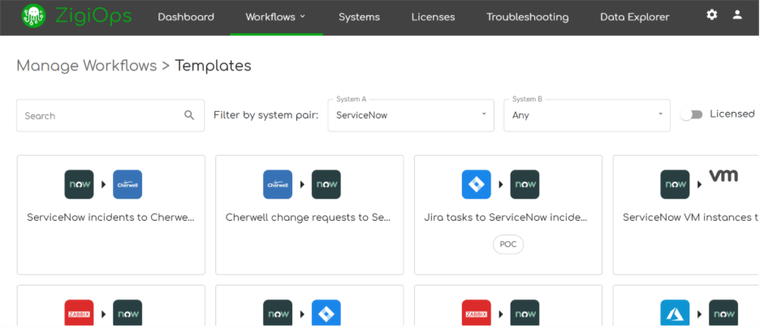
Check our ServiceNow integrations.
Specialized ServiceNow Jira Integration Capabilities
ZigiOps excels in complex servicenow jira integration scenarios, providing purpose-built functionality for co-managed queues, advanced field mapping, and two-way workflow synchronization. The platform's servicenow jira templates include pre-configured mappings for common use cases while maintaining full customization flexibility for unique organizational requirements. These templates accelerate deployment while ensuring best practices are followed from the initial implementation.
The servicenow jira integration capabilities include sophisticated correlation logic, automatic conflict resolution, and intelligent data transformation that ensures seamless operation across both platforms. This makes ZigiOps particularly valuable for organizations that rely heavily on both ServiceNow and Jira for their operational workflows, enabling true collaboration between ITSM and development teams without manual intervention or data synchronization challenges.
Advanced servicenow jira features unique to ZigiOps include support for complex project hierarchies, agile workflow integration, release management coordination, and sophisticated assignment logic that handles the nuanced differences between ServiceNow's group-based assignments and Jira's individual user assignments.
Enterprise Security and Compliance Features
ZigiOps addresses the stringent security requirements of enterprise environments through comprehensive security frameworks that exceed industry standards. The platform's security architecture includes multiple layers of protection, from network security to data encryption and access controls, ensuring that servicenow integrations meet the most demanding compliance requirements.
Key security capabilities include:
- End-to-end encryption for all data in transit
- Zero-trust architecture with comprehensive access controls
- Advanced credential management with rotation capabilities
- Network segmentation and IP whitelisting
- Comprehensive audit logging and forensic capabilities
- Compliance frameworks including SOX, GDPR, HIPAA support
Comprehensive Comparison: ZigiOps vs Other ServiceNow Integrators
| Criteria | ZigiOps | Other ServiceNow Integrators |
|---|---|---|
| No-code configuration | Fully no-code for all workflows | Often limited or requires scripting |
| Security | ISO 27001 certified, no data storage, full encryption | Varies widely, sometimes stores or proxies data |
| Deployment | Runs inside customer infrastructure | Often cloud-only or hybrid with vendor-controlled components |
| Scalability | Unlimited transactions, HA-ready | Transaction limits, scalability constraints |
| Mapping flexibility | Advanced field-level, nested data, custom metadata | Basic mapping with limited transformation rules |
| Co-managed queue support | Deep, purpose-built functionality | Rare or requires custom development |
| Monitoring and logging | Real-time dashboards, health checks, alerts | Limited visibility or external monitoring required |
| License transparency | Predictable, volume-friendly pricing with discounts for multiple ServiceNow integrations | Per-transaction or per-connector pricing that scales unpredictably |
| Supported platforms | 30+ ITSM, DevOps, monitoring, and cloud systems | Often fewer supported systems or extra cost for connectors |
| Implementation speed | Go live in hours with templates | Lengthy setup or reliance on services teams |
The comparison clearly demonstrates why ZigiOps has become the preferred servicenow integrator for enterprises that prioritize security, scalability, and operational control. The platform's comprehensive feature set addresses the full spectrum of integration requirements without compromising on any critical capabilities, while maintaining the simplicity and usability that enables rapid deployment and adoption across diverse organizational contexts.
Real-World Success Story: How Red River Leverages a ServiceNow Integrator to Power Multi-Platform ITSM
Red River, a Tier-1 government-certified MSP, supports large enterprises and public sector agencies with strict SLAs and complex multi-platform environments. Their central ServiceNow instance must stay perfectly aligned with client systems such as Jira, Freshservice, Zendesk, and external ServiceNow environments. Without proper automation through a reliable servicenow integrator, this created fragmented visibility, manual handoffs, escalation delays, and major bottlenecks in co-managed queues that threatened their ability to meet contractual obligations and maintain customer satisfaction.
The complexity of managing multiple client environments while maintaining service quality standards required Red River to implement sophisticated servicenow integrations that could handle diverse technical requirements and security constraints across different organizational contexts. The challenge extended beyond technical integration to encompass business process alignment, compliance requirements, and the need to maintain competitive advantage in a demanding market.
The Multi-Platform Challenge
Red River needed automated, accurate synchronization between ServiceNow and client systems to eliminate manual updates, maintain context during escalations, and ensure round-trip visibility for all stakeholders. Co-managed queues with Jira were especially difficult, requiring full field parity and reliable two-way updates. The challenge extended beyond simple data synchronization to include:
- Complex workflow automation across multiple client environments
- Maintaining security boundaries while enabling collaboration
- Ensuring SLA compliance across integrated systems
- Managing different data formats and business processes
- Providing real-time visibility to all stakeholders
- Handling varying levels of client technical sophistication
- Maintaining audit trails for government compliance requirements
- Supporting 24/7 operations across multiple time zones
- Scaling operations without proportional increases in staffing
The ServiceNow Integrator Solution
Using ZigiOps as their primary servicenow integrator, Red River deployed secure, no-code integrations across Jira, Freshservice, Zendesk, and other ServiceNow instances. The platform provided real-time, two-way synchronization without scripts or middleware, creating a unified ITSM backbone that scales across customer environments while maintaining the security and compliance requirements of government and enterprise clients. The implementation transformed their service delivery model from reactive to proactive, enabling predictable service quality regardless of client system complexity.
The implementation showcased the full capabilities of an enterprise-grade servicenow integrator, demonstrating how proper integration architecture can transform complex multi-vendor environments into streamlined operational workflows that deliver consistent business value across diverse client relationships.
Comprehensive ServiceNow Jira Integration Implementation
The servicenow jira integration component was particularly critical for Red River's co-managed queue operations. ZigiOps enabled sophisticated two-way synchronization that maintained data integrity while providing the flexibility needed for diverse client requirements. The servicenow jira integration handled complex scenarios including custom field mapping, workflow state correlation, and intelligent conflict resolution that ensured seamless operation even when clients modified their Jira configurations or workflows.
The sophistication of the servicenow jira implementation included support for multiple Jira project types, custom agile workflows, complex approval processes, and integration with development toolchains that extended beyond basic ticket synchronization to encompass comprehensive DevOps lifecycle management.
Key Capabilities Delivered by the ServiceNow Integrator
- Automatic creation of Jira tasks for specific ServiceNow queues with intelligent routing
- Two-way sync of fields, comments, status changes, and optional attachments
- Advanced mapping for priority, state, assignment groups, contact info, and custom metadata
- De-escalation automation when Jira issues are downgraded or resolved
- Real-time monitoring, health checks, and comprehensive troubleshooting tools
- Multi-client environment support with isolated data flows
- Automated SLA tracking and escalation management
- Comprehensive audit trails for compliance reporting
- Custom notification frameworks for stakeholder communication
- Performance analytics and optimization recommendations
- Disaster recovery and business continuity capabilities
- Multi-language support for international client requirements
Beyond the core servicenow jira functionality, Red River also uses ZigiOps to integrate ServiceNow with Freshservice and Zendesk, ensuring consistent ticket handling and eliminating email-based coordination. ServiceNow to ServiceNow eBonding workflows provide full metadata parity for enterprise clients with their own ServiceNow instances, creating seamless multi-organization collaboration that maintains security boundaries while enabling operational transparency.
Measurable Business Impact
Red River now operates with significantly faster escalations, complete cross-platform visibility, and automated workflows that reduce manual effort and strengthen SLA compliance. The implementation of ZigiOps as their primary servicenow integrator resulted in:
- 65% reduction in manual ticket handling tasks
- 40% improvement in average resolution times
- Near-elimination of data synchronization errors
- Enhanced client satisfaction due to improved visibility
- Significant reduction in operational overhead
- 30% improvement in first-call resolution rates
- 25% reduction in escalation response times
- Improved staff productivity and job satisfaction
- Enhanced competitive positioning in MSP market
- Better compliance with government security requirements
"The co-managed queue integration has been a game changer. Our clients use Jira, we use ServiceNow, and now we're all in sync without any manual handoffs. ZigiOps handles it all and keeps our support pipeline moving smoothly across all our client environments."Red River Operations Team
The success at Red River demonstrates the transformative power of implementing a comprehensive servicenow integrator platform that addresses both technical and business requirements while providing the scalability and reliability needed for mission-critical operations in demanding environments.
Essential ServiceNow Integrations for Modern IT Operations
Understanding which servicenow integrations provide the most value helps organizations prioritize their integration initiatives and maximize return on investment. Modern IT environments typically require a combination of ITSM, DevOps, monitoring, and business system integrations to achieve optimal operational efficiency. The strategic selection and implementation of these integrations can transform organizational capabilities and competitive positioning.
The evolution of IT operations has created new integration requirements that extend beyond traditional ITSM boundaries to encompass cloud platforms, security tools, business applications, and emerging technologies. Organizations that successfully implement comprehensive integration strategies position themselves for sustained competitive advantage and operational excellence.
Critical ServiceNow Integrations for Enterprise Success
The most impactful servicenow integrations typically include:
- DevOps Tool Integration: Connecting ServiceNow with Jira, Azure DevOps, GitLab, and other development platforms
- Monitoring System Integration: Linking ServiceNow with monitoring tools like Nagios, SolarWinds, and Datadog
- Security Platform Integration: Connecting SIEM tools and security platforms for incident correlation
- Cloud Platform Integration: Integrating with AWS, Azure, and Google Cloud for infrastructure management
- Business System Integration: Connecting CRM, ERP, and other business-critical applications
- Communication Platform Integration: Linking with Slack, Microsoft Teams, and other collaboration tools
- Asset Management Integration: Connecting CMDB with discovery tools and inventory systems
- Knowledge Management Integration: Linking with documentation and knowledge base systems
- Vendor Management Integration: Connecting with supplier and third-party service provider systems
- Compliance and Audit Integration: Linking with GRC platforms and audit management systems
Each integration category requires specific technical capabilities from the chosen servicenow integrator, making platform selection critical for long-term success. Organizations should evaluate integration platforms based on their ability to handle the full spectrum of required integrations rather than focusing solely on immediate needs.
Advanced ServiceNow Jira Integration Scenarios
The sophistication of servicenow jira integrations often determines their success in real-world environments. Advanced scenarios that require robust integration capabilities include:
- Multi-project Jira environments with complex routing rules
- Agile workflow integration with ServiceNow change management
- Development task correlation with ServiceNow incidents and problems
- Release coordination between ServiceNow and Jira project timelines
- Cross-team collaboration through synchronized work queues
- Portfolio management integration with ServiceNow project management
- DevSecOps workflow integration with security requirements
- Continuous integration/continuous deployment (CI/CD) pipeline integration
- Test management correlation with ServiceNow quality assurance processes
- Requirements traceability across both platforms
These advanced servicenow jira use cases demonstrate why selecting an enterprise-capable integration platform is essential for organizations that rely on sophisticated workflows across both systems. The complexity of modern development and operations requires integration solutions that can adapt to evolving methodologies and toolchains.
Emerging Integration Requirements
The rapidly evolving technology landscape continues to create new integration requirements that forward-thinking organizations must consider when selecting a servicenow integrator. Emerging integration categories include:
- Artificial Intelligence and Machine Learning platforms
- IoT device management and monitoring systems
- Container orchestration and microservices platforms
- Edge computing and distributed infrastructure
- Blockchain and distributed ledger technologies
- Robotic Process Automation (RPA) platforms
Organizations should evaluate servicenow integrator platforms based on their ability to adapt to emerging technologies and support future integration requirements, not just current needs.
Best Practices for Evaluating and Implementing ServiceNow Integrator Solutions
Successful implementation of a servicenow integrator requires careful planning, thorough evaluation, and adherence to proven best practices. Organizations that follow structured approaches to integration implementation achieve better outcomes and avoid common pitfalls that can derail projects. The investment in proper planning and evaluation pays dividends throughout the lifecycle of the integration implementation.
The complexity of modern enterprise environments demands methodical approaches to integration planning that consider technical requirements, business processes, organizational change management, and long-term strategic objectives. Organizations that shortcut the evaluation process often face significant challenges during implementation and ongoing operations.
Pre-Implementation Evaluation Checklist for ServiceNow Integrator Projects
- Define your required systems and data entities early in the evaluation process
- Test API credentials and permissions before beginning mapping configuration
- Start from pre-built templates to reduce configuration time and minimize errors
- Use filters and conditions to prevent loops, duplicates, and data conflicts
- Enable comprehensive monitoring and alerts from day one of operation
- Plan for both vertical and horizontal scaling to accommodate growth
- Test integrations thoroughly with real workflows before production rollout
- Establish clear success criteria and measurement frameworks
- Plan for ongoing maintenance and optimization activities
- Document integration configurations for future reference and troubleshooting
- Conduct thorough security reviews and penetration testing
- Develop comprehensive backup and disaster recovery procedures
- Create detailed operational runbooks and troubleshooting guides
- Establish governance frameworks for integration management
- Plan for user training and change management activities
Security and Compliance Considerations for ServiceNow Integrator Selection
When evaluating a servicenow integrator, security and compliance capabilities must be thoroughly assessed to ensure alignment with organizational requirements and regulatory obligations. Key security evaluation criteria include:
- Data handling and storage policies
- Encryption standards for data in transit and at rest
- Access control and authentication mechanisms
- Audit trail and logging capabilities
- Compliance certification status (ISO 27001, SOC 2, etc.)
- Network security controls and IP whitelisting
- Vulnerability management and security patching procedures
- Incident response capabilities and procedures
- Data residency and sovereignty requirements
- Third-party security assessments and certifications
Organizations in regulated industries should prioritize servicenow integrator platforms that demonstrate comprehensive security frameworks and compliance readiness to avoid future audit issues or security vulnerabilities. The cost of addressing security deficiencies after implementation far exceeds the investment in proper security evaluation upfront.
Performance and Scalability Planning
Effective servicenow integrations must be designed to handle current volumes while accommodating future growth. Performance planning considerations include:
- Current and projected transaction volumes
- Peak load handling requirements
- Response time expectations and SLA requirements
- High availability and disaster recovery needs
- Geographic distribution and latency considerations
- Resource utilization monitoring and optimization
- Capacity planning and expansion procedures
- Performance testing and validation methodologies
- Bottleneck identification and resolution strategies
- Long-term growth projection and planning
Selecting a servicenow integrator with unlimited transaction capabilities and robust scalability features ensures that performance remains optimal as business requirements evolve and grow. Organizations should also consider the operational overhead associated with scaling different integration approaches.
"The most successful integration implementations are those that plan for scale from day one, rather than attempting to retrofit scalability after the initial deployment."Enterprise Architecture Best Practices, Gartner
Change Management and User Adoption
Technical success of servicenow integrations must be complemented by effective change management to ensure user adoption and business value realization. Key change management considerations include:
- Stakeholder engagement and communication strategies
- Training programs for end users and administrators
- Process documentation and standardization
- Performance metrics and success measurement
- Continuous improvement and optimization processes
- User feedback collection and incorporation
Organizations that invest in comprehensive change management alongside technical implementation achieve significantly better outcomes and user satisfaction with their servicenow integrator deployments.
Integration Governance and Management
Establishing proper governance frameworks is essential for successful long-term management of servicenow integrations. Key governance elements include:
- Integration standards and architectural guidelines
- Data quality and validation requirements
- Change control and approval processes
- Performance monitoring and optimization procedures
- Security compliance and audit requirements
- Disaster recovery and business continuity planning
- Vendor management and contract oversight
- Integration portfolio planning and roadmap development
Effective governance ensures that servicenow integrator platforms continue to deliver value while maintaining security, compliance, and operational excellence standards throughout their operational lifecycle.
Strategic Decision Making: Choosing the Right ServiceNow Integrator for Long-Term Success
Selecting the right servicenow integrator determines how effectively your IT teams collaborate, how quickly issues are resolved, and how reliably data flows between platforms across your entire technology ecosystem. The ideal solution must be secure, scalable, no-code, and capable of supporting complex enterprise workflows without compromise or ongoing technical debt. This decision represents a strategic investment that will impact organizational capabilities for years to come.
The decision extends beyond immediate technical requirements to encompass long-term strategic considerations including vendor stability, platform evolution, support quality, and total cost of ownership. Organizations that take a comprehensive approach to servicenow integrator selection position themselves for sustainable success in their integration initiatives while avoiding the costly mistakes that plague hasty technology selections.
The ZigiOps Advantage for Enterprise ServiceNow Integrations
ZigiOps delivers exactly the combination of capabilities that enterprise organizations require, enabling organizations like Red River to automate data flows, improve visibility, and eliminate manual effort across multi-platform IT environments. The platform's comprehensive approach to servicenow integrations ensures that both current needs and future requirements are addressed through a single, unified solution that grows with organizational requirements.
The platform's proven track record in complex environments, combined with its innovative approach to security, scalability, and usability, makes ZigiOps the preferred choice for organizations that demand excellence from their servicenow integrator platform. The no-code approach eliminates technical barriers while maintaining the sophistication required for enterprise-scale operations, creating a unique combination of accessibility and capability.
Future-Proofing Your ServiceNow Integration Strategy
Modern servicenow integrations must be designed to accommodate evolving business requirements, changing technology landscapes, and growing operational complexity. ZigiOps provides the flexibility and extensibility needed to adapt to future changes without requiring platform migration or significant reconfiguration. The platform's architecture anticipates change and provides the tools necessary to adapt quickly to new requirements.
The platform's commitment to supporting the latest API versions, emerging technologies, and evolving integration patterns ensures that organizations can maintain their competitive advantage as their integration requirements mature and expand. This forward-looking approach protects the investment in integration infrastructure while enabling continuous innovation and improvement.
Total Cost of Ownership Considerations
When evaluating servicenow integrator platforms, organizations must consider the total cost of ownership beyond initial licensing fees. Key cost factors include:
- Implementation and configuration costs
- Ongoing maintenance and support requirements
- Training and skills development needs
- Scaling costs as volumes increase
- Integration expansion and new system onboarding
- Disaster recovery and business continuity capabilities
- Compliance and security audit requirements
- Performance optimization and tuning activities
ZigiOps addresses these cost considerations through its comprehensive platform approach, unlimited transaction model, and no-code configuration capabilities that minimize ongoing operational overhead while maximizing business value delivery.
Making the Strategic Decision
The selection of a servicenow integrator should align with broader organizational strategies around digital transformation, operational excellence, and competitive positioning. Organizations should evaluate platforms based on their ability to support strategic objectives, not just immediate technical needs. This strategic perspective ensures that integration investments contribute to long-term organizational success.
"Integration platforms are no longer just technical tools—they are strategic enablers that determine an organization's ability to adapt, innovate, and compete in rapidly changing markets."Forrester Digital Business Strategy Research
When organizations evaluate different servicenow integrator options, they should consider not only current capabilities but also the vendor's roadmap, investment in research and development, and commitment to supporting evolving customer needs. The best servicenow integrator platforms demonstrate continuous innovation while maintaining backward compatibility and stability for existing implementations.
ROI and Business Value Measurement
Measuring the success of a servicenow integrator implementation requires establishing clear metrics and measurement frameworks that align with business objectives. Key performance indicators typically include:
- Reduction in manual effort and operational overhead
- Improvement in incident resolution times
- Enhanced data accuracy and consistency
- Increased team productivity and satisfaction
- Better compliance with SLA requirements
- Improved customer satisfaction scores
- Cost savings from process automation
- Enhanced visibility and reporting capabilities
Organizations that implement comprehensive measurement frameworks for their servicenow integrations are better positioned to optimize performance, demonstrate value to stakeholders, and make informed decisions about future integration initiatives.
The Importance of Expert Support and Partnership
The complexity of enterprise servicenow integrator implementations often requires expert guidance and ongoing support to achieve optimal outcomes. Key considerations for vendor partnership include:
- Quality and availability of technical support
- Implementation services and best practices guidance
- Training and certification programs
- Community resources and knowledge sharing
- Regular platform updates and feature enhancements
- Long-term vendor stability and market presence
The best servicenow integrator vendors demonstrate commitment to customer success through comprehensive support offerings, regular platform updates, and active engagement with the user community to drive continuous improvement and innovation.
Ready to optimize your ServiceNow integrations with a proven enterprise platform?
Book a Demo and experience how ZigiOps transforms ITSM and DevOps workflows through advanced servicenow integrator capabilities. Or try it hands-on: Request a Cloud Trial.
Discover why leading enterprises choose ZigiOps as their preferred servicenow integrator for mission-critical integration requirements. Experience the difference that true no-code configuration, enterprise-grade security, and unlimited scalability can make in your organization's integration success story. The future of IT operations depends on the integration decisions you make today—choose a platform that will grow with your organization and support your strategic objectives for years to come.