Choosing an Atlassian Integration Partner: What to Ask Before You Sign

If you implement Jira, Jira Service Management, or Confluence for clients, “integration partner” means something different for you than it does for the client themselves. It's the independent technology vendor whose platform you standardize on to connect Atlassian products to everything else your clients run: ServiceNow, Azure DevOps, Salesforce, their monitoring stack. Choosing well determines whether integration is a profitable, repeatable line in every engagement, or the part that quietly erodes your margin.
That distinction matters more in 2026 than it used to. Atlassian has stopped selling new Data Center subscriptions, which means a growing number of your clients are migrating to Cloud on a fixed clock, and plugin apps built for the old architecture don't always carry over cleanly. If the integration logic you delivered lives entirely inside a Jira-native plugin, a migration year is exactly when that logic gets exposed, and exactly when the client calls you.
This guide covers how to evaluate an Atlassian integration partner — an independent technology vendor you standardize on for integration delivery, certification or not — and the questions worth asking before you build your practice around one.
Where Jira and Confluence Engagements Actually Overrun
Ask any team implementing Jira or Confluence where the timeline slips, and it's rarely the workflow configuration. It's the integration nobody scoped correctly:
- A plugin-based integration inherits every upgrade risk on both sides. Plenty of plugin apps connect Jira to ServiceNow, Dynatrace, or Salesforce well, and many need a matching plugin installed on the connected system too, not just on Jira. Even where only one side needs it, a Jira upgrade, a Cloud migration, or a version change on the connected system can each independently break the same integration.
- A Groovy script becomes a single point of failure. The engineer who wrote the custom listener eventually moves on, and whoever inherits it gets undocumented code nobody wants to touch, let alone extend.
- Migration years turn hidden debt into a support fire. A Data Center to Cloud migration forces every custom integration to be re-tested, and that's exactly when a client discovers whether the last vendor built something durable.
None of this is a reason to avoid integration work. It's a reason to decide deliberately whether you build that capability with your own engineers or standardize on an independent technology partner built for it.
Plugin Apps vs. Standalone Integration Partners: Not the Same Job
The Atlassian Marketplace lists both kinds of app, but it matters whether an app runs as a plugin or as a standalone application. That has nothing to do with which systems it can reach: plenty of plugin apps connect Jira to ServiceNow, Dynatrace, or Salesforce well.
| Type | What it actually does | When you need it |
|---|---|---|
| Plugin app | Runs inside Jira, Confluence, or JSM as an add-on; connecting it to an external system like ServiceNow often means installing a matching plugin on that side too | A lightweight, native-feeling integration where both sides update in step |
| In-house scripting (Groovy/REST) | Custom-built connections your own engineers write and maintain | One-off, low-recurrence integration requests |
| Standalone integration partner | Runs as its own application, connecting via API without embedding into either product's codebase | Integrations that need stability, scale with time, and survive Atlassian upgrades and updates on the connected system independently |
A plugin runs inside the Atlassian instance itself, and reaching a system like ServiceNow or Salesforce often means installing a matching plugin on that side too, which means two separate release cycles to track instead of one. Even where only the Jira-side plugin is needed, it still inherits version dependencies from both the Jira, Confluence, or JSM release it's built for and whatever release of the connected system it talks to. A standalone application runs independently of either product's release cycle, and doesn't add to or modify the code of the systems it connects. That's the difference worth standardizing a delivery approach around, not reach, and not where something happens to be listed.
Why This Decision Carries More Weight Right Now
Two forces are converging on integration decisions in 2026:
- Data Center migrations are on a real clock. Atlassian has stopped selling new Data Center subscriptions, with existing licenses running through 2029. Every integration built on Data Center-specific scripting needs a migration plan of its own, on top of the platform migration itself.
- Plugin-based integrations carry that migration risk twice over. A plugin app that connects Jira to ServiceNow, BMC, Dynatrace, or Salesforce often needs a matching plugin installed on the connected system as well, and even where it doesn't, it still runs inside the Atlassian instance, exposed to both the Jira migration and whatever changes on the connected system's side, independently.
None of this means you need the largest global systems integrator in the room. It means you need a partner whose integration approach outlasts the next Atlassian architecture shift, not just the next sprint.
Evaluation Criteria: Scripted vs. Independent Partner Delivery
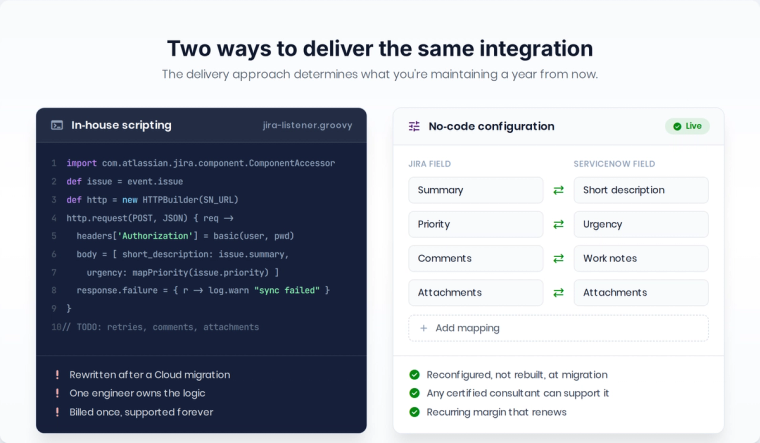
Whether the work runs through your own engineers or a platform you resell, the delivery approach determines what you're maintaining a year from now, and how the margin behaves over the life of the account.
| Evaluation criterion | In-house scripting (Groovy/REST) | Independent integration partner |
|---|---|---|
| Time to first integration live | Weeks to months, scoped per engagement | Typically hours to days, configured through a UI |
| Who owns maintenance after a Jira upgrade | Your engineers, off the back of a support ticket | The platform vendor, as part of the subscription |
| Survives a Cloud or Data Center migration | Often needs to be rewritten | Reconfigured, not rebuilt, in most cases |
| Revenue shape | One-time project fee, then unpaid support debt | Recurring margin that renews with the client |
| Deployment flexibility | Whatever your engineers have time to build | Cloud, on-premise, and hybrid supported out of the box |
The revenue shape is the one worth sitting with. A scripted integration bills once and then quietly costs you every time a client's other system changes its API. An independent integration partner turns the same work into a subscription that renews, with your margin attached to it every year.
What to Actually Check Before You Standardize
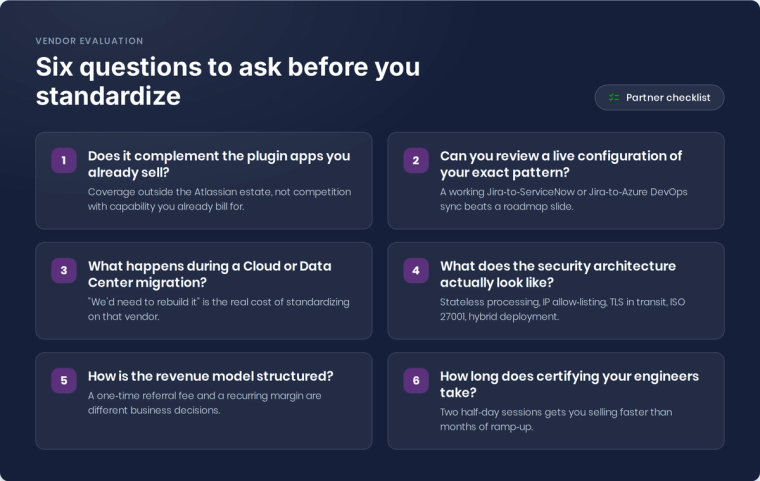
A handful of questions separate an integration partner that strengthens your practice from one that becomes a support burden.
- Does it complement the plugin apps you already sell, or does it duplicate them? You want a partner that covers what's outside the Atlassian estate, not one that competes with capability you already bill for.
- Can you review a live configuration of the exact pattern you need? A demo of the specific Jira-to-ServiceNow or Jira-to-Azure DevOps pattern your client needs tells you more than a roadmap slide.
- What happens to the integration during a Cloud or Data Center migration? If the honest answer is "we'd need to rebuild it," you've found the real cost of standardizing on that vendor.
- What does the security architecture actually look like? Ask directly: stateless processing, IP allow-listing, TLS in transit, independent certifications like ISO 27001, and support for cloud, on-premise, and hybrid deployment are what regulated clients ask about before anything else.
- How is the revenue model structured? A referral fee once versus a recurring margin that scales with how much of the delivery and support you own is a materially different business decision for your practice.
- How long does it take to certify your engineers? A platform your team can get trained on in a couple of half-day sessions gets you selling faster than one requiring months of ramp-up.
Where ZigiOps Fits These Criteria
ZigiOps is built around this exact checklist. It sits alongside the plugin apps you already sell rather than duplicating them, and the difference isn't reach, it's architecture:
- Architecture: ZigiOps is listed in the Atlassian Marketplace as a standalone application, not a Jira, Confluence, or JSM plugin. It doesn't need installing on both ends of an integration, doesn't run inside the Atlassian instance, and doesn't depend on Atlassian's plugin framework or release cycle.
- Stability: It doesn't modify or add to the code of the systems it connects to, ServiceNow, BMC, Dynatrace, Salesforce, and 50-plus others, so a Jira upgrade or a version change on the connected side doesn't bring the integration down with it.
- Delivery: There's no Groovy, no scripting, and no single point of failure. Configuration happens in a UI, so any certified consultant on your team can build, hand over, and support an integration.
- Security: The architecture is stateless, with IP allow-listing and TLS throughout, plus ISO 27001 certification, and cloud, on-premise, and hybrid deployment are all supported for regulated clients.
- Revenue: Recurring rather than one-off. Subscriptions renew the way a scripting project never does, with margin running from a 15% referral commission up to 40% for partners who own full delivery.
- Certification: Two half-day sessions plus a practical configuration exercise, with a free internal license issued the same week.
ZigiOps already runs inside more than 60 Fortune 500 organizations, including four of the world's four largest IT services firms. The Atlassian partner program page has the specifics for a partner's own client base.
The Revenue Model Question: Referral, Reseller, or Owned Delivery
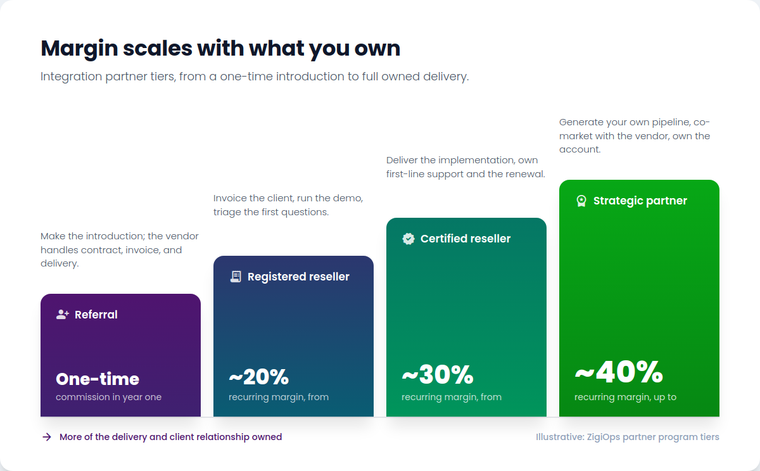
Independent integration partner programs generally structure margin around how much of the client relationship and delivery you own. As an illustrative example, ZigiOps structures its own partner program across four tiers:
| Tier | You do | You earn |
|---|---|---|
| Referral | Make the introduction; the vendor handles contract, invoice, and delivery | 15% commission in year one |
| Registered Reseller | Invoice the client, run the demo, triage first questions | Recurring margin from around 20% |
| Certified Reseller | Deliver the implementation, own first-line support and the renewal | Recurring margin from around 30% |
| Strategic Partner | Generate your own pipeline, co-market with the vendor, own the account | Recurring margin up to around 40% |
These tiers describe standing within the technology vendor's own partner program, not Atlassian's. Whichever vendor you evaluate, ask where their tiers land relative to this shape, what triggers a margin increase, and whether registered opportunities carry any deal protection.
What This Looks Like Once a Partner Standardizes
The clearest evidence isn't the pitch, it's what happens after a partner standardizes. Red River runs a co-managed service model where its clients' Jira and service desk environments need to stay in sync with ServiceNow, monitoring tools, and other systems across the client base. Rather than scripting that routing engagement by engagement, Red River standardized delivery on ZigiOps and now operationalizes the same pattern repeatedly, which is the difference between one-off project work and a repeatable, recurring line in the practice.
Add This to Your Practice Without Adding Headcount
Before you standardize your practice on any Atlassian integration partner, ask to see a live Jira-to-ServiceNow or Jira-to-Azure DevOps sync configured in front of you, not just described in a slide. If you'd rather look at the margin, the training path, and how a no-code, ISO 27001-certified platform fits your existing Atlassian practice, book a partner call and bring your client base.
Frequently asked questions
Do we need to be a certified Atlassian Solution Partner before we add an independent integration partner to our practice?
No. Independent integration delivery and Atlassian's own partner program are separate things. Most integration technology programs are open to Solution Partners, Marketplace Partners, and Atlassian-focused consultancies alike, regardless of current certification status.
Will an independent integration partner conflict with the plugin apps we already sell?
No, they complement each other, and it isn't really about which systems each one reaches, since many plugin apps do connect Jira to ServiceNow, Salesforce, or a monitoring tool. The difference is architecture: a plugin app runs inside the Atlassian instance and often needs a matching plugin installed on the connected system too, while a standalone integration partner runs as its own application on neither side. You can sell both at once.
What's the difference between a plugin app and a standalone integration partner?
Less about which systems each one reaches, since plenty of plugin apps connect Jira to external tools too, and more about architecture. A plugin app runs inside Jira, Confluence, or JSM, and often needs a matching plugin installed on the connected system as well, which means it inherits version dependencies from both sides. A standalone integration partner runs as its own application, connecting via API without embedding into either product's codebase.
Can a Jira integration survive a Data Center to Cloud migration?
It depends entirely on how it was built. A platform-configured integration is generally reconfigured rather than rebuilt during a migration, since the logic lives in the platform's UI. A custom Groovy script or Data Center-specific plugin often needs to be rewritten for Cloud.
How long does it take to certify a partner on a no-code Jira integration platform?
With a mature platform, certification for a partner's engineers typically runs two half-day sessions plus a hands-on configuration exercise, versus months of ramp-up for a team learning to write and maintain custom Jira scripting.