How to Choose the Best ServiceNow Integration Partner in 2026

If you implement ServiceNow for clients, “integration partner” means something different for you than it does for the client themselves. It's the technology vendor whose platform you standardize on to deliver the connectivity work between ServiceNow and everything else your clients run: Jira, Azure DevOps, Salesforce, their monitoring stack. Choosing well determines whether integration is a profitable, repeatable line in every statement of work, or the part of the engagement that quietly erodes your margin.
That distinction matters because integration is rarely optional anymore. As ServiceNow has absorbed more of the ITSM, ITOM, ITBM, and CSM stack, almost every implementation now touches at least one system outside ServiceNow. The question isn't whether your practice needs an integration capability. It's whether you build it with your own engineers on Flow Designer and scripted REST work, or standardize on a technology partner and resell it.
This guide covers how to evaluate a ServiceNow integration partner — a technology vendor you standardize on for integration delivery — and the questions worth asking before you build your practice around one.
Why Integration Is the Part of the Engagement That Overruns
Ask any ServiceNow implementation partner where their estimates go wrong, and integration work comes up fast. A few reasons it keeps happening:
- Everything outside ServiceNow is bespoke. IntegrationHub spokes cover common patterns, but the rest becomes scripted REST work, scoped optimistically and delivered late.
- CMDB and CI relationships are where estimates break. Mapping configuration items, relationships, and reference fields across systems is the work that rarely gets quoted correctly up front.
- The client owns the maintenance afterward, which means you do too. Every time ServiceNow or the connected system changes an API, the client calls you, and you absorb the change order or eat the cost.
- The integration line item is usually the one that erodes margin on the whole engagement. Even when the ServiceNow implementation itself runs on schedule and on budget.
None of this is a reason to avoid integration work. It's a reason to decide deliberately whether you build that capability in-house or standardize on a technology partner built for it.
Scripted Delivery vs. a Technology Partner: What Actually Changes
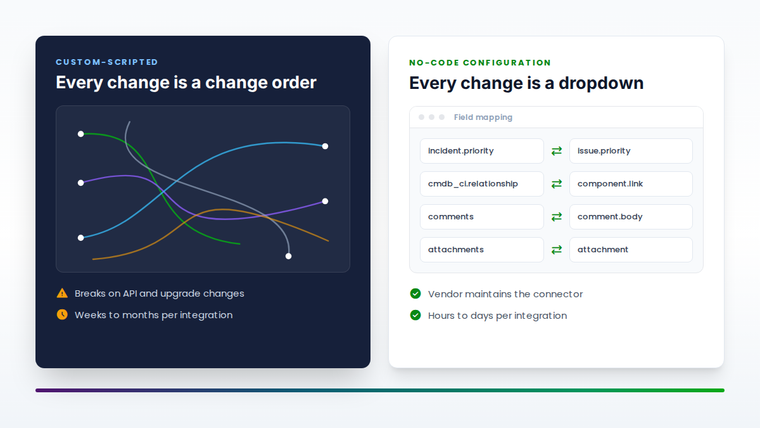
Whether your engineers write the integration by hand or configure it through a platform you resell, the choice determines what you're maintaining a year from now, and how the margin behaves over the life of the account.
| Evaluation criterion | In-house scripted delivery (Flow Designer / REST) | Standardized technology partner |
|---|---|---|
| Time to first integration live | Weeks to months, scoped per engagement | Typically hours to days, configured through a UI |
| Who owns maintenance when an API changes | Your engineers, off the back of a support ticket | The platform vendor, as part of the subscription |
| CMDB and CI relationship handling | Scripted case by case, easy to underquote | Built into the mapping model as a standard field type |
| Revenue shape | One-time project fee, then unpaid support debt | Recurring margin that renews with the client |
| Deployment flexibility | Whatever your engineers have time to build | Cloud, on-premise, and hybrid supported out of the box |
The revenue shape is the one worth sitting with. A scripted integration bills once and then quietly costs you every time it breaks. A standardized technology partner turns the same work into a subscription that renews, with your margin attached to it every year.
What to Actually Check Before You Standardize
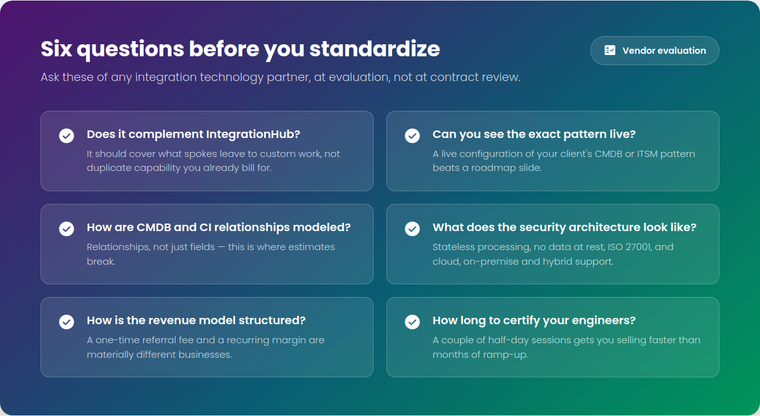
A handful of questions separate a technology partner that strengthens your practice from one that becomes a support burden.
- Does it complement IntegrationHub, or does it duplicate it? You want a partner that covers what spokes leave to custom work: CMDB depth, multi-system real-time sync, complex conditional logic, not one that competes with capability you already bill for.
- Can you review a live configuration of the exact pattern you need? A demo of the specific CMDB or ITSM integration pattern your client needs tells you more than a roadmap slide or a generic sales demo.
- How are CMDB and CI relationships modeled, not just individual fields? This is the part of integration work that's hardest to quote accurately, and it's where a mature platform should show its depth.
- What does the security architecture actually look like? Ask for the vendor's own security documentation directly: stateless processing, no data stored at rest, independent certifications like ISO 27001, and support for cloud, on-premise, and hybrid deployment are what regulated clients ask about before anything else.
- How is the revenue model structured? A referral fee once versus a recurring margin that scales with how much of the delivery and support you own is a materially different business decision for your practice.
- How long does it take to certify your engineers? A platform your team can get trained on in a couple of half-day sessions gets you selling faster than one requiring months of ramp-up.
Where ZigiOps Fits These Criteria
ZigiOps is built around this exact checklist. It sits alongside IntegrationHub rather than duplicating it, covering the CMDB depth, multi-system real-time sync, and conditional logic that spokes typically leave to custom work, so a partner's engineers configure a live pattern through a UI instead of scoping a scripted build. CMDB and CI relationships are modeled as a standard field type rather than something scripted case by case, which is usually where estimates break. The security architecture is stateless, stores no client data at rest, and holds ISO 27001 certification, with cloud, on-premise, and hybrid deployment all supported for regulated clients. The revenue model scales with how much of the delivery a partner owns, from a one-time referral commission up to a recurring margin around 40% for partners running full implementation and renewal, and engineers are typically trained and certified within a couple of half-day sessions rather than months of ramp-up. The ServiceNow partner program page has the specifics for a partner's own client base.
The Revenue Model Question: Referral, Reseller, or Owned Delivery
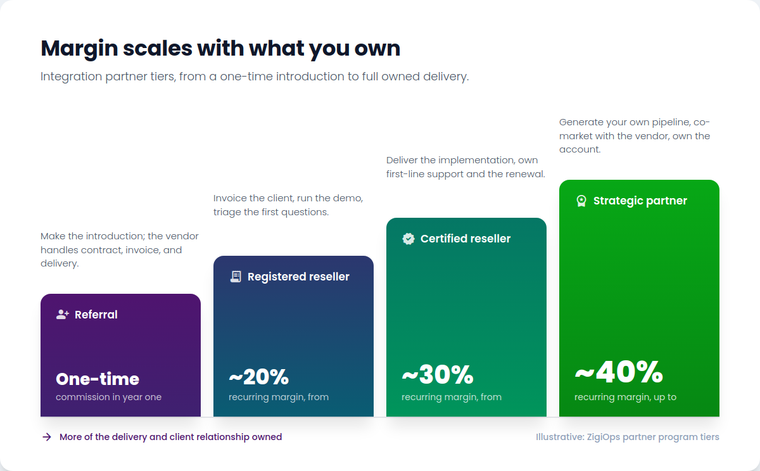
Integration technology partner programs generally structure margin around how much of the client relationship and delivery you own. As an illustrative example, ZigiOps structures its own partner program across four tiers:
| Tier | You do | You earn |
|---|---|---|
| Referral | Make the introduction; the vendor handles contract, invoice, and delivery | One-time commission in year one |
| Registered Reseller | Invoice the client, run the demo, triage first questions | Recurring margin from around 20% |
| Certified Reseller | Deliver the implementation, own first-line support and the renewal | Recurring margin from around 30% |
| Strategic Partner | Generate your own pipeline, co-market with the vendor, own the account | Recurring margin up to around 40% |
These tiers describe standing within the technology vendor's own partner program, not ServiceNow's. Whichever vendor you evaluate, ask where their tiers land relative to this shape, and specifically what triggers a margin increase: revenue run-rate, certified headcount, or something else entirely.
What This Looks Like Once a Partner Standardizes
The clearest evidence isn't the pitch, it's what happens after a partner standardizes. Red River runs a co-managed service model where its client's ServiceNow service desk needs to stay in sync with subcontractors and software vendors running Jira or Azure DevOps. Rather than scripting that routing engagement by engagement, Red River standardized delivery on ZigiOps and now operationalizes the same pattern across its client base, which is the difference between one-off project work and a repeatable, recurring line in the practice.
Add This to Your Practice Without Adding Headcount
Before you standardize your practice on any ServiceNow integration partner, ask to see the ServiceNow-Jira and CMDB enrichment configuration live, not described in a slide. If you'd rather look at the margin, the training path, and how a no-code, ISO 27001-certified platform fits your existing ServiceNow practice, book a partner call and bring your client base.
Frequently asked questions
Does adding an integration technology partner compete with the IntegrationHub work we already bill?
No, it should complement it. Use IntegrationHub where a spoke fits the pattern. A good technology partner covers what spokes leave to custom work: CMDB depth, multi-system real-time sync, and complex conditional logic, so you're not turning down work you don't currently have a repeatable way to deliver.
Do we need to be an official ServiceNow partner before we add an integration technology partner to our practice?
No. Integration delivery capability and ServiceNow's own partner program are separate things. You can add integration capability, and start reselling a technology vendor's platform, regardless of your current standing with ServiceNow directly.
Is a no-code integration platform secure enough for regulated ServiceNow clients?
Look for a stateless architecture with no customer data stored at rest, independent certifications like ISO 27001, and support for cloud, on-premise, and hybrid deployment. Those are the specific points regulated clients' security teams tend to ask about first, and a mature platform should answer all of them directly, with documentation you can hand to the client's security team.
How is margin usually structured when reselling an integration platform?
Most programs scale margin with how much of the delivery and client relationship you own, from a one-time referral commission up to a recurring margin in the 30 to 40 percent range for partners who own implementation, support, and the renewal.
Can integrations delivered through a technology partner run in a client's on-premise environment?
With a mature platform, yes. Cloud, on-premise, and hybrid deployments should all be supported, which matters for clients with data residency or regulatory requirements that rule out a cloud-only integration layer.