ERP Integrator vs. iPaaS: What's the Real Difference in 2026?

An ERP integrator is a software tool, platform, or professional service that connects an Enterprise Resource Planning system to other business applications, ensuring data flows accurately between them without manual intervention. As enterprise stacks grow more complex, the term "ERP integrator" is often used interchangeably with iPaaS, middleware, and no-code platforms. This guide untangles the definitions and helps IT decision-makers choose the right approach.
Why the Confusion Exists
When procurement teams search for an ERP integrator, they land on three very different categories: System Integrator (SI) firms that build and maintain integrations as a managed service; Traditional middleware and ESB tools like MuleSoft or IBM App Connect that require developer configuration; and Modern iPaaS and no-code platforms that let IT teams build integrations through a guided UI without writing code. Each describes itself as an ERP integrator. The differences in cost, speed, and long-term maintenance are significant.
What a Traditional ERP Integrator Actually Delivers
A traditional ERP integrator typically offers custom-built connectors tailored to your specific ERP version and data schema, transformation logic written in proprietary scripting languages (Groovy, DataWeave, XSLT), on-premise or hybrid deployment often required for SAP or Oracle environments with strict data residency rules, and high initial cost involving professional services fees, licence fees, and ongoing maintenance contracts.
The upside is deep customisation. The downside is that every update to your ERP or connected system potentially breaks the integration, triggering expensive re-development cycles. According to IBM's enterprise integration research, the hidden cost of keeping custom integrations aligned with evolving ERP systems is consistently one of the most underestimated budget items IT teams face.
What iPaaS Actually Means and Why the Definition Has Shifted
iPaaS (Integration Platform as a Service) originally described cloud-hosted middleware that moved integration work from on-premise servers into the cloud. In practice, most iPaaS platforms still require developers. Workato uses a recipe model that business analysts can learn, but complex ERP integrations still demand technical expertise. G2's enterprise iPaaS market data consistently notes that the gap between what iPaaS vendors promise and what non-technical teams can actually build remains wide.
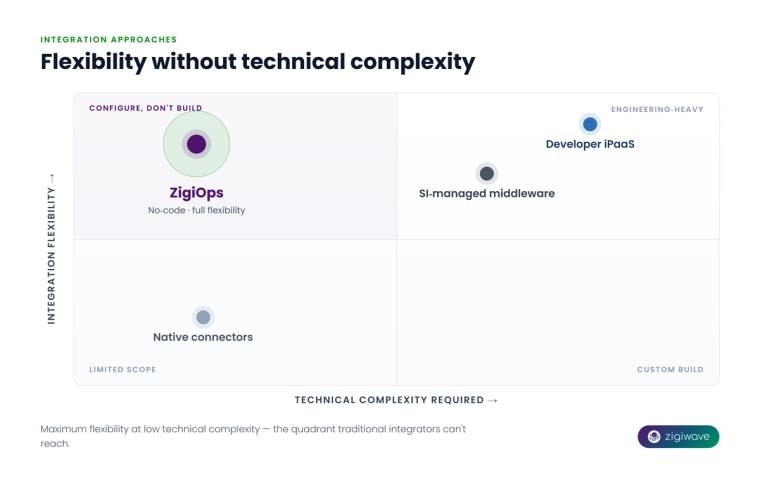
The category has bifurcated into developer-oriented iPaaS (MuleSoft, Boomi, Informatica) requiring coding or low-code scripting, and no-code integration platforms (ZigiOps) using configuration through a guided UI with no scripting required. For ERP integration specifically, the distinction matters enormously.
ERP Integrator vs. iPaaS vs. No-Code: A Direct Comparison
| Criterion | Traditional SI / Middleware | Developer iPaaS (Workato, Boomi) | No-Code Platform (ZigiOps) |
|---|---|---|---|
| Setup time | Weeks to months | Days to weeks | Hours to days |
| Technical requirement | Developer + SI team | Developer or advanced admin | IT admin (no coding) |
| Flexibility | Very high | High | Very high |
| Maintenance burden | High (custom code breaks on updates) | Medium | Low (connector-managed) |
| Cost model | Project + retainer fees | Per-task or per-transaction pricing | Flat fee, unlimited transactions |
| Data storage | Varies (often stores data in transit) | Cloud storage in vendor environment | No data stored - in-memory only |
| Security certifications | Varies by vendor | SOC 2 typical | ISO 27001 (ZigiOps) |
| Update resilience | Low (custom scripts break) | Medium | High (managed connectors update automatically) |
| Deployment model | On-premise or cloud | Cloud (some hybrid) | On-premise, cloud, or hybrid |
The Hidden Cost of the Integrator Model
The biggest misconception about ERP integrators is that the headline license or project fee represents the true cost. Three costs that rarely appear in the initial proposal:
Break-fix maintenance: Every ERP vendor releases updates. SAP releases twice a year, Oracle quarterly. Each update can alter API endpoints, field structures, or authentication methods. Custom-built integrations break. With a managed connector platform, the vendor updates the connector; with custom middleware, your team does the re-development.
Per-transaction pricing at scale: Several iPaaS platforms price by task or transaction volume. An ERP integration syncing thousands of records daily can generate millions of transactions per month. At scale, per-transaction pricing makes ERP integration dramatically more expensive than the initial estimate.
Knowledge lock-in: Custom middleware built by a SI firm lives in opaque configuration files. When the developer leaves or the SI contract ends, the integration becomes a liability. ZigiOps addresses all three: managed connectors update automatically, pricing is unlimited transactions on a flat license, and every integration is visible and editable through a documented UI.
When a Traditional ERP Integrator Still Makes Sense
There are scenarios where a traditional SI or developer iPaaS is the right call: greenfield ERP implementations where a SI is already engaged for the full deployment and integration work is bundled in; highly bespoke data transformations requiring custom business logic beyond what a no-code platform expression engine supports; legacy ERP versions (SAP R/3, Oracle E-Business Suite pre-12.1) with no REST API surface; and regulated industries with procurement requirements mandating SI-level accountability. Outside these scenarios, the overhead of traditional ERP integrators is difficult to justify.
Real-World ERP Integration Scenarios Where No-Code Wins
SAP incidents to Jira bugs, bidirectional
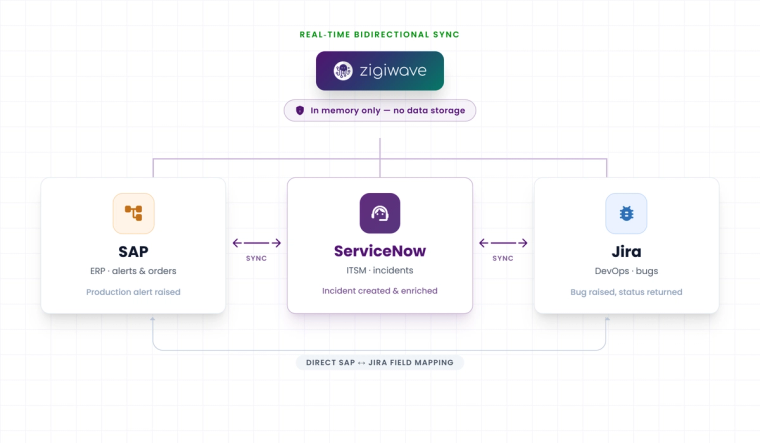
A manufacturing firm runs ServiceNow for incident management and Jira for engineering. SAP generates system alerts that become ServiceNow incidents. With ZigiOps, an IT admin maps fields through a guided wizard -- SAP alert to ServiceNow incident to Jira bug -- with bidirectional comment and status sync configured in an afternoon. No developer required.
Microsoft Dynamics to Salesforce customer data sync
A sales team needs Salesforce CRM in sync with Dynamics 365 ERP for accounts, orders, and contract data. ZigiOps provides pre-built Salesforce and Dynamics 365 connectors with field mapping through a UI. No recipe authoring required.
Oracle ERP to ServiceNow CMDB
Assets managed in Oracle need to populate the ServiceNow CMDB in real time. ZigiOps handles this as a standard no-code integration: configure the source, define the trigger, map fields to CMDB CI fields, set filters. No coding. No middleware servers to maintain.
How ZigiOps Positions Against the Traditional ERP Integrator Model
ZigiOps is a standalone, no-code enterprise integration platform — not a plugin, not a middleware service, not a SI engagement. It differentiates on six points:
- 100% code-free configuration through a guided UI
- No data storage — data flows from source to destination in memory only; nothing is stored on ZigiOps infrastructure, which matters for ERP data containing financial or HR records
- ISO 27001 certified for enterprise security
- Unlimited transactions on flat-fee licensing
- Standalone application not tied to any platform marketplace
- A guided UI built for IT admins, not developers
For organisations evaluating ERP integrators, ZigiOps sits in the sweet spot where integration complexity is high but technical staff availability is limited.
Choosing Between an ERP Integrator and a No-Code Platform
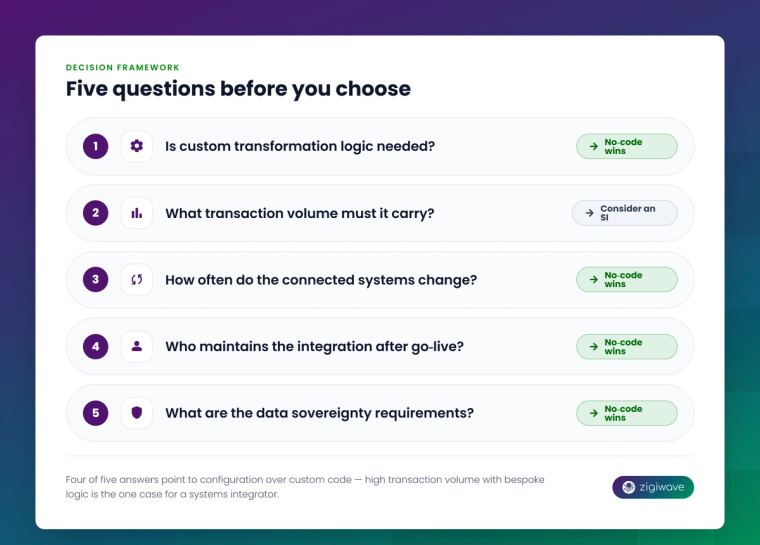
Ask these five questions before committing:
- Does the integration require custom business logic that a guided expression engine cannot handle?
- How many transactions do you process per month — per-task pricing becomes expensive at scale?
- How quickly do your connected systems update — quarterly ERP releases break custom middleware regularly?
- Who will maintain the integration after go-live — SI dependency or IT admin self-service?
- What are your data sovereignty requirements — does ERP data need in-memory-only processing to satisfy GDPR or CMMC requirements?
If the answers point toward standard field mapping, high transaction volumes, and limited technical staff, a no-code platform is the right architecture. Book a demo to see how ZigiOps handles ERP integration without code, without an SI engagement, and without storing your data in transit.
Ready to Connect Your ERP Without Code?
ZigiOps connects SAP, Oracle, and Microsoft Dynamics to ServiceNow, Jira, Salesforce, and 60+ enterprise tools through a guided no-code UI — with no data stored in transit, ISO 27001 certified security, and flat-fee unlimited-transaction licensing. Schedule a demo and see how ERP integration works without a developer or an SI engagement.
Frequently asked questions
What is an ERP integrator?
An ERP integrator is a tool or service that connects an ERP system (such as SAP, Oracle, or Microsoft Dynamics) to other business applications, enabling automated data exchange without manual re-entry. The term covers traditional middleware, iPaaS platforms, and no-code integration tools.
Is iPaaS the same as an ERP integrator?
Not exactly. iPaaS (Integration Platform as a Service) is one category of ERP integrator — specifically cloud-hosted platforms. Traditional ERP integrators also include on-premise middleware and SI-managed custom integrations. No-code platforms like ZigiOps are a sub-category of iPaaS focused on configuration-only setup.
What does an ERP integration tool cost?
Costs vary widely: SI-managed integrations typically run $50,000–$500,000+ in project fees plus annual retainers. Developer iPaaS platforms charge per task or per user. No-code platforms like ZigiOps use flat-fee licensing with unlimited transactions — the most predictable model at scale.
Can you integrate ERP systems without a developer?
Yes, with a mature no-code integration platform. ZigiOps provides pre-built connectors for SAP, Oracle, Microsoft Dynamics, and Salesforce, with guided field mapping and transformation expressions that require no scripting.
How is ZigiOps different from Workato for ERP integration?
Workato is a low-code iPaaS that requires recipe authoring — developer-leaning for complex ERP scenarios. ZigiOps is 100% code-free, does not store transferred data, and uses flat-fee unlimited-transaction pricing. For IT teams without dedicated integration developers, ZigiOps requires significantly less technical investment.
Does ZigiOps support SAP integration?
Yes. ZigiOps integrates with SAP — connecting SAP events and data to ITSM tools (ServiceNow, Jira), monitoring platforms, and CRM systems — through its no-code connector framework.
What is the difference between middleware and an integration platform?
Middleware is the traditional term for software that connects applications at the infrastructure level, typically requiring developer configuration. An integration platform (iPaaS or no-code) abstracts away infrastructure complexity. The practical difference: middleware requires more technical expertise; modern integration platforms prioritise speed and accessibility for IT teams.
How long does it take to set up an ERP integration with ZigiOps?
For standard ERP-to-ITSM or ERP-to-CRM integrations using ZigiOps pre-built connectors, setup typically takes hours to a few days, depending on field mapping complexity. There is no coding, no custom scripting, and no SI engagement required.